×
Get a Free Consultation
Fill out the form below and our team will get back to you shortly.
Thank you! Your submission has been received!
Oops! Something went wrong while submitting the form.



UAE hotels are absorbing several new costs at once: annual music licensing fees from 1 December 2026 (up to AED 25,000 per property), ongoing 5% VAT, 9% corporate tax above AED 375,000, a 15% domestic minimum top-up tax for large multinational groups, and mandatory e-invoicing starting 1 January 2027 for businesses above AED 50 million revenue.
This lands in a hard year. UAE hotel occupancy fell nearly 28 percentage points year on year in H1 2026 and RevPAR dropped 31.8%, according to CBRE using CoStar data. Dubai occupancy fell to 56.4% from 81%.
Dubai responded with AED 2.5 billion in economic relief across two packages, including waivers on the Tourism Dirham and the 7% municipal fee on hotel and restaurant bills.
The systems problem: compliance costs are per entity, per outlet and per period. Property management systems track guests. They do not consolidate multi-entity finance.
What hotels are doing: moving the finance layer to a cloud ERP, keeping the PMS for operations, and integrating the two so revenue, tax and cost data reconcile once instead of three times.
The deadline that matters most: large businesses had to appoint an accredited service provider by 30 October 2026 and must be live on e-invoicing by 1 January 2027.
Any one of these obligations would be routine. The difficulty in 2026 is that they overlap.
Hotels in the UAE now manage, in the same twelve months:
• VAT at 5%, with returns, input recovery and the documentation to support both
• Corporate tax at 9% on taxable income above AED 375,000, under Federal Decree-Law No. 47 of 2022
• A 15% domestic minimum top-up tax for UAE entities inside multinational groups with consolidated revenue of EUR 750 million or more, effective for financial years starting on or after 1 January 2025
• Music licensing fees from 1 December 2026 under Ministerial Resolution No. 136 of 2026
• E-invoicing, with mandatory go-live on 1 January 2027 for businesses at or above AED 50 million revenue
• Tourism Dirham and municipality fees, currently subject to relief in Dubai but structurally still part of the model
Each has a different basis of calculation, a different filing rhythm and a different owner inside the business. That is what makes the aggregate hard, not the individual rates.
Compliance costs are easier to absorb when revenue is strong. In H1 2026, it was not.
CBRE, drawing on CoStar data, reported UAE hotel occupancy down roughly 28 percentage points year on year through June, with RevPAR falling 31.8%. Dubai took the sharpest hit, with occupancy at 56.4% against 81% in H1 2025 and RevPAR down 35.2%. Abu Dhabi held up better at 66.8% occupancy, supported by domestic demand and an events-led calendar. Ras Al Khaimah fell to 49.3%.
The cause was regional disruption to air travel rather than anything structural in the destination. Capacity has been returning, and S&P Global Ratings expects GCC tourism to begin recovering from the fourth quarter of 2026.
Dubai's government response was substantial. A AED 1 billion package in March 2026 deferred municipal sales fees and the Tourism Dirham for three months from 1 April. A second package of AED 1.5 billion followed in May with 33 initiatives, and it converted deferrals into outright exemptions: the Tourism Dirham, the 7% municipal fee on hotel and restaurant bills, holiday home permit and licence fees, and event permit and cancellation charges.
That relief protected liquidity. It did not remove the underlying obligations, and it will not last indefinitely. Which is why the operators who used 2026 well spent it fixing the systems rather than only managing the cash.
Most UAE hotels run a capable PMS. Opera, Mews, Cloudbeds and similar platforms handle reservations, rates, folios and housekeeping well.
The gap appears one level up. A PMS is built around the property and the guest. Compliance is built around the legal entity and the tax period. Those are different shapes.
Specific failure points show up repeatedly:
• Multi-entity structures: A group may hold each property in a separate company, with F&B outlets in another, and a management entity above. The PMS does not consolidate these.
• Intercompany transactions: Central procurement, shared services and management fees create intercompany entries that must eliminate cleanly on consolidation.
• Revenue classification for VAT: Rooms, food, beverage, spa, event hire and service charges do not all behave identically. Misclassification surfaces during audit, not before.
• Corporate tax computation: The 9% calculation starts from accounting profit adjusted for specific items. If the trial balance needs manual rework each period, the computation inherits every error.
• Recurring compliance costs: Music licences, permits and classification fees have defined terms and renewal dates. They belong in a system that amortises and alerts.
• E-invoicing: From January 2027, in-scope invoices must be issued as structured data through an accredited service provider. PDFs will not satisfy the requirement.
The result in most groups is a month-end that runs on exports. Revenue from the PMS, payables from one system, payroll from another, all meeting in a spreadsheet that one person understands.
The pattern is consistent. Keep the PMS for operations. Move the finance and compliance layer into a cloud ERP. Integrate the two so data flows once.
In practice, that means:
Each property, outlet and management company posts to the same structure. Consolidation stops being a rebuild and becomes a report. For groups operating across emirates or into Saudi Arabia and Oman, this is what makes a group tax position visible during the year rather than after it.
Daily revenue from the PMS lands in the ERP already split by revenue type, outlet and tax treatment. Rooms, F&B, spa and events each carry their own VAT logic. Nobody reclassifies anything by hand.
A music licence, a trade licence and a classification fee are all the same object: a defined-term cost with a renewal date. In a system like Oracle NetSuite, each becomes a record with an amortisation schedule, an owner and an alert. The AED 25,000 music licence for a 200-plus room property stops being a surprise in December.
Corporate tax returns are due nine months after the financial year end. That sounds generous until the underlying books need three months of cleanup first. Groups that maintain a continuously reconciled ledger convert a scramble into a review.
The UAE is using a Peppol-based decentralised model. Invoices must be issued in a structured format such as PINT AE and exchanged through an accredited service provider. Building that into the ERP's existing invoice process is straightforward. Bolting it onto a spreadsheet-driven process is not.
For a broader look at what the FTA's rollout requires beyond the dates below, see our UAE e-invoicing readiness checklist.
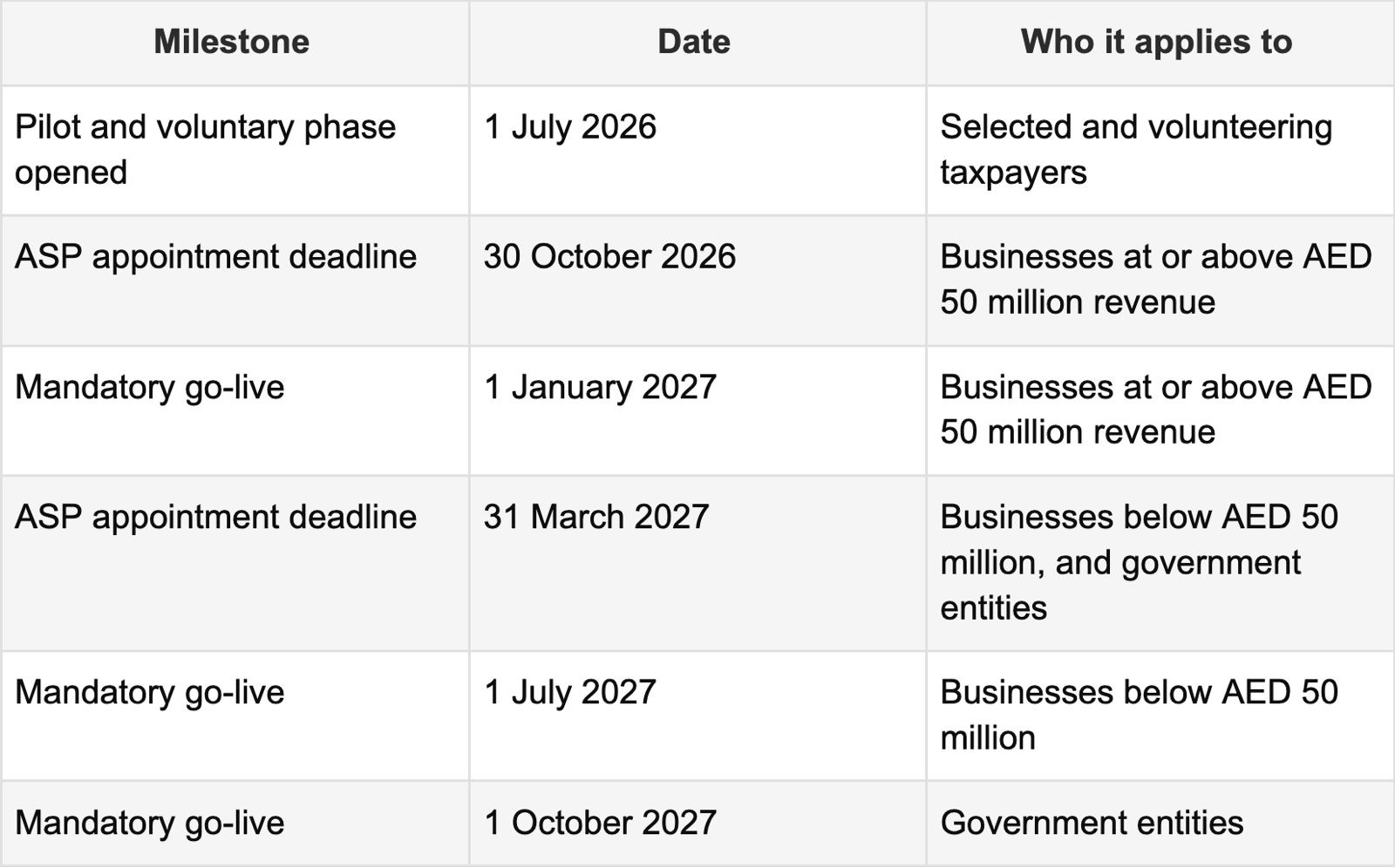
Two points worth flagging. First, the ASP appointment deadline for the first cohort moved from 31 July 2026 to 30 October 2026 through an amendment to Ministerial Decision No. 244 of 2025. The go-live date did not move. Second, Cabinet Decision No. 106 of 2025 sets an administrative penalty of AED 5,000 per month for non-compliance, which accrues until the position is corrected.
For a hotel group above the AED 50 million threshold, January 2027 is a hard date and the preparation window is now measured in weeks.
Take a mid-sized UAE group: three hotels totalling 640 rooms, eight F&B outlets, two spas and a holding company. Five legal entities.
Music licensing: The 220-room five-star property pays the AED 25,000 cap. The 240-room property also reaches the cap. The 180-room four-star property falls in the AED 18,000 band. Outlets operating under separate licences may be assessed on their own basis. Call it roughly AED 70,000 to AED 90,000 across the group, before any DJ programming.
E-invoicing: Group revenue is comfortably above AED 50 million, so all five entities need to be live by 1 January 2027, with an ASP appointed.
Corporate tax: Five entities, five computations, one group view. If the group is part of a multinational above EUR 750 million consolidated revenue, a separate effective tax rate assessment applies under the domestic minimum top-up tax.
VAT: Monthly or quarterly returns across the entities, with input recovery that depends on correct classification at the point of posting.
None of these numbers is frightening. The workload is. Ten years ago this group might have added a finance headcount. In 2026 they are more likely to consolidate the systems, because the volume of separate deadlines has grown faster than the volume of transactions.
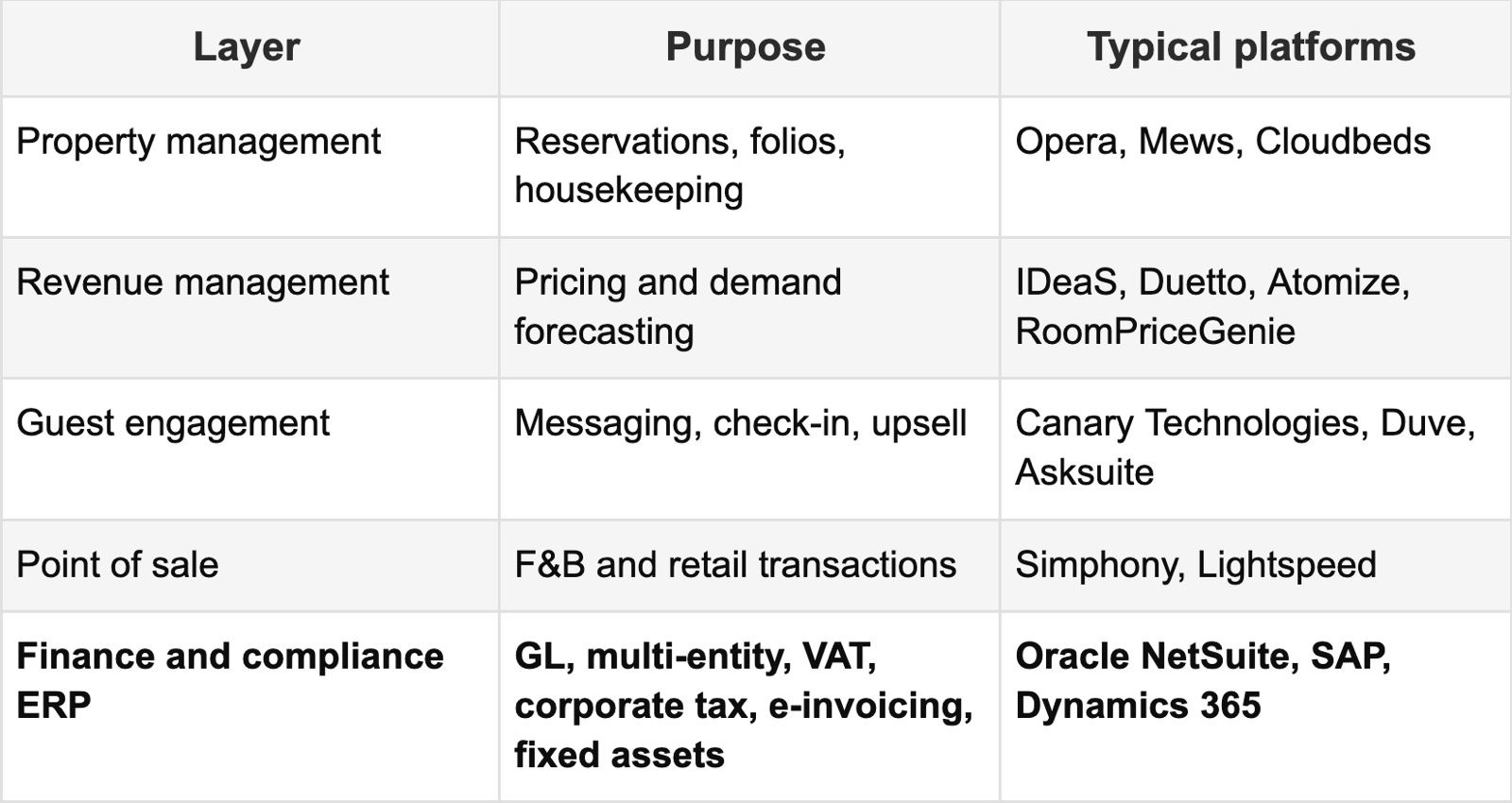
The ERP row is the one most often missing in mid-market UAE groups. The others get bought because they clearly drive revenue. The finance layer gets deferred until a deadline forces it.
Adoption is real, not theoretical. Canary Technologies' 2026 hospitality survey of more than 400 technology decision makers found that 82% of hoteliers expect AI use across their organisation to increase in the next year, and 85% plan to allocate at least 5% of their IT budget to AI tools.
The tools that rank consistently in 2026 comparisons, grouped by the job they do:
Revenue management: IDeaS G3 is the most widely adopted at portfolio scale. Duetto is favoured for granular, segment-level pricing through its Open Pricing model and reports more than 7,200 hotel, casino and resort customers. Atomize, now part of Mews, and RoomPriceGenie serve independents and smaller groups. Properties using AI-driven dynamic pricing commonly report RevPAR improvements of 3% to 7% in stable markets and 10% to 15% in volatile ones, which is directly relevant given 2026 demand swings.
Guest engagement: Canary Technologies covers messaging, digital check-in, upsell and payments in one system. Asksuite focuses on direct booking conversion. Duve handles guest journey automation.
Operations: Optii Solutions applies predictive scheduling to housekeeping, with reported productivity gains above 20%.
Finance: This is where the ERP earns its place. NetSuite's 2026 releases include Bill Capture, which extracts vendor invoice data using OCR and machine learning at over 90% accuracy on standard layouts and cuts manual AP entry by a large margin. Text Enhance generates record content. Exception management scans financial data continuously and flags anomalies for review. NetSuite Next adds natural language querying and agentic workflows, though parts of it are still rolling out, so treat vendor demonstrations of fully autonomous agents as roadmap rather than shipped capability.
One caveat that applies across all of these. Simple features work regardless of data quality. Forecasting, anomaly detection and agentic workflows are only as good as the ledger underneath them. Fixing the data model comes first.
Do UAE hotels need a separate ERP if they already have a PMS?
Usually yes, once the group runs more than one legal entity. A PMS manages the property and the guest. An ERP manages the entity, the general ledger, consolidation, VAT, corporate tax and e-invoicing. The two integrate rather than compete. Single-property independents can sometimes run on a PMS plus accounting software, but multi-entity groups rarely can.
How much will music licensing cost a UAE hotel?
It depends on class and room count. One and two star properties pay AED 50 per room up to 50 rooms, then AED 5,000 or AED 8,000 in higher bands. Three star properties pay AED 120 per room up to 50 rooms, then AED 12,000 or AED 18,000. Four and five star properties pay AED 150 per room up to 50 rooms, then AED 15,000, AED 18,000 or AED 25,000. The cap for hotels is AED 25,000 a year. Fees start on 1 December 2026.
When do UAE hotels have to start e-invoicing?
Businesses with annual revenue at or above AED 50 million must be live from 1 January 2027, having appointed an accredited service provider by 30 October 2026. Businesses below AED 50 million follow from 1 July 2027, with an ASP appointed by 31 March 2027. The penalty for non-compliance is AED 5,000 per month under Cabinet Decision No. 106 of 2025.
Does the 15% top-up tax apply to most UAE hotels?
No. The domestic minimum top-up tax applies only to UAE entities within multinational groups whose consolidated revenue reaches EUR 750 million in at least two of the four preceding financial years. It applies to financial years starting on or after 1 January 2025. Most independent and mid-market UAE hotel groups remain on the standard 9% regime. International brand affiliation does not by itself bring an owning company into scope, since the test looks at the group's own consolidated revenue.
How long does a hotel ERP implementation take in the UAE?
For a mid-market group with three to six entities, a focused finance-first implementation typically runs three to six months. The variables are data quality in the legacy system, the number of integrations, and how quickly the group can agree a single chart of accounts. Phasing matters. Groups that try to move finance, procurement, payroll and PMS integration simultaneously take longer and carry more risk than those that sequence them.
The hotels handling 2026 well are not the ones with the lowest compliance costs. They are the ones who can see those costs clearly, by entity, before the deadline rather than after it.
That visibility is a systems outcome, not an effort outcome. No amount of diligence makes a spreadsheet consolidate five entities reliably at month-end while a new tariff, a new tax computation and a new invoicing mandate all change underneath it.
SaasWorx implements Oracle NetSuite for UAE hospitality groups working through exactly this transition, with the finance layer built around UAE VAT, corporate tax and the 2027 e-invoicing requirement. You can read more about NetSuite cloud ERP for hospitality or book a consultation to walk through your entity structure.