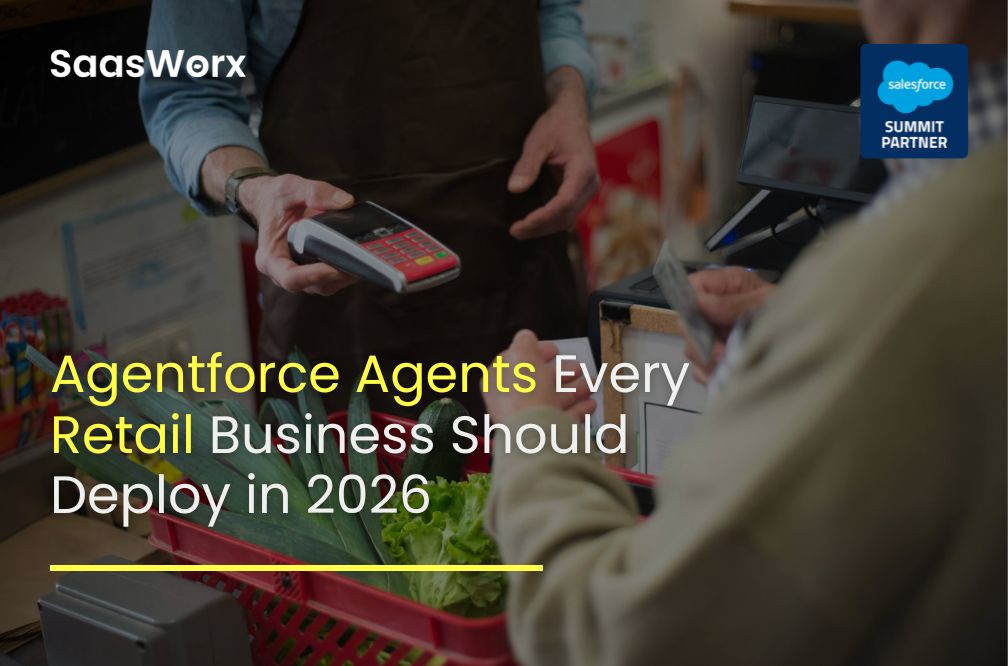
Agentforce Agents Every Retail Business Should Deploy in 2026


Let’s Work Together
Retail in 2026 is an environment where customer expectations keep rising and the cost of meeting them manually keeps climbing. Shoppers expect fast, accurate answers. They want to find what they are looking for without friction. When something goes wrong with an order, they want it resolved quickly, not in 48 hours.
The brands keeping pace are not necessarily the ones with the biggest teams. They are the ones that have figured out where autonomous AI agents fit into their operations and deployed them in the right places.
Agentforce, Salesforce's autonomous AI platform, now includes a purpose-built suite for retail and consumer goods. Salesforce reports that online traffic from AI assistants grew 119% year-over-year in the first half of 2025, and AI agents are projected to influence a growing share of global digital orders in 2026. The shift is underway. The question for retail teams is not whether AI agents belong in their operations, but which ones to prioritize.
Here are five Agentforce agents that retail businesses from mid-market chains to enterprise consumer goods brands are deploying in 2026 and the specific problems each one solves.
1. The Order Support Agent
The Problem It Solves
"Where is my order?" is one of the highest-volume inquiries in retail customer service. It is also one of the most repetitive. A customer contacts support, a service rep pulls up the order, reads back a status, answers a follow-up question, and closes the ticket. Multiply that by hundreds of interactions a day, and a significant portion of your service team's time goes to something a well-configured AI agent can handle entirely.
What the Agent Does
An Agentforce order support agent connects to your order management system and Commerce Cloud data to handle WISMO (Where Is My Order) inquiries autonomously. When a customer contacts support through your website chat, SMS, or WhatsApp the agent:
- Identifies the customer and retrieves their order history
- Provides real-time order status and tracking information
- Sends proactive alerts if a delay or issue is detected
- Handles modifications address changes, order cancellations, quantity adjustments within defined parameters
- Flags duplicate orders or anomalies before they become service issues
The agent handles the entire interaction without a human rep needing to touch it. Complex situations where an order has multiple issues, requires a refund beyond a certain amount, or involves a complaint get escalated with full context attached.
Real-world use: Quip, the dental care brand, implemented Agentforce for service support and saw a 48% increase in contact deflection meaning nearly half of incoming contacts were resolved without a human agent.
Why deploy this first: Volume and speed. This agent delivers visible results quickly because order inquiries are high-frequency and well-defined. It frees your service team to focus on interactions that genuinely need human judgment.
2. The Guided Shopping Agent
The Problem It Solves
Static browsing is losing ground. Customers do not want to scroll through hundreds of products, they want to describe what they are looking for and get relevant recommendations. The brands that can deliver a conversational shopping experience have a conversion advantage over those still relying on keyword search and category menus.
Salesforce introduced Intent-Aware Search for Agentforce Commerce in March 2026, moving beyond literal keyword matching to understand shopper intent through natural language. This is the infrastructure behind guided shopping agents.
What the Agent Does
A guided shopping agent operates on your website, mobile app, or embedded in a messaging channel. When a customer starts browsing or searches for something, the agent:
- Asks clarifying questions to understand what the customer actually needs
- Recommends products based on purchase history, stated preferences, and current inventory
- Shows alternatives when a preferred item is out of stock, including waitlist or back-in-stock notification options
- Surfaces promotions relevant to the customer's context not generic sitewide offers
- Guides the customer through to checkout, reducing cart abandonment at the final step
Real-world use: Williams-Sonoma deployed an AI sous chef agent on their website that helps customers plan menus, find relevant products, and follow recipes step by step. The agent turns browsing into a goal-directed experience.
Why deploy this: Conversion rate and average order value. Customers who get specific, personalized guidance convert at higher rates and buy more per transaction than those left to browse on their own.
3. The Returns and Refunds Agent
The Problem It Solves
Returns are expensive to process and frustrating for customers when handled slowly. For retailers with high return volumes especially post-holiday periods or in categories like apparel and consumer electronics the returns process is a major cost center and a frequent source of customer dissatisfaction.
A poorly handled return does not just cost you the refund. It costs you the relationship.
What the Agent Does
An Agentforce returns agent handles the return and refund process from start to finish, within the parameters your team defines. When a customer initiates a return:
- The agent retrieves the order, confirms eligibility under your return policy, and initiates the return
- It generates a return label, provides drop-off instructions, and sets a clear expectation for refund processing time
- It handles exchanges offering alternatives if the customer wants a replacement rather than a refund
- It monitors return receipt and triggers the refund automatically once the item is confirmed received
- Exceptions damaged returns, disputed eligibility, or items outside policy get escalated to a human with full context
Customers get a self-service resolution at any hour. Your service team handles edge cases, not the standard process.
Why deploy this: Returns are a trust moment. A fast, frictionless resolution keeps the customer relationship intact. An agent that handles this consistently, at scale, converts a cost center into a retention tool.
4. The Loyalty and Retention Agent
The Problem It Solves
Loyalty programs have a retention problem. Most major retail loyalty programs have high enrollment and low active usage. Members forget about their points, miss out on rewards, and do not feel like the program is paying attention to them. The result is that brands invest in loyalty infrastructure but do not see the retention lift they expect.
What the Agent Does
A loyalty agent uses your customer data purchase history, reward balance, engagement patterns, seasonal behavior to proactively engage members at the right moments. It:
- Notifies customers when they are close to a reward threshold and suggests a purchase that would push them over
- Surfaces personalized offers tied to past purchase categories, not generic promotions
- Re-engages lapsed members with a relevant incentive before they churn
- Responds to loyalty-related inquiries points balance, how to redeem, tier status without a service rep involvement
- Monitors account health signals and flags at-risk members to your marketing team
Why deploy this: Customer lifetime value. A loyalty agent that personalizes outreach based on actual behavior keeps active members engaged longer and reactivates lapsed ones at a fraction of the cost of new customer acquisition.
5. The Store Associate Support Agent
The Problem It Solves
In-store associates spend time answering product questions they do not always have full answers to, checking inventory across locations, and looking up customer order history when helping with a return or exchange. These tasks take them away from the customer interaction itself.
For retail businesses with physical locations, associate enablement is an often-overlooked area where AI delivers fast ROI.
What the Agent Does
An associate support agent runs inside the tools your in-store team already uses a tablet, a POS-connected app, or a Slack-based interface. During a customer interaction, the associate can:
- Ask the agent a product question and get an accurate answer sourced from your product knowledge base
- Check real-time inventory across locations and offer alternatives or in-store pickup from another store
- Pull up a customer's purchase history and loyalty status to personalize the in-store experience
- Log feedback from floor interactions customer requests, frequently asked questions, product issues directly from the conversation
Salesforce's Agentforce Actions for Point-of-Sale rolled into pilot in Spring 2026, extending the agent capability directly into POS workflows.
Why deploy this: Associate confidence and transaction quality. An associate who can answer any product question accurately and check inventory without leaving the customer closes more sales and handles returns more smoothly.
How to Sequence Your Deployment
Not every retail business needs all five agents on day one. The order in which you deploy depends on where your biggest volume and pain points are.
A practical sequence for most retail operations:
- Order support agent - High volume, clear ROI, fastest to configure
- Returns agent - Reduces service team load and improves customer experience
- Guided shopping agent - Requires more data readiness but drives direct revenue
- Loyalty agent - Most value when your loyalty data is clean and accessible
- Associate support agent - Valuable for physical retail; sequencing depends on your in-store tech stack
Before any of these agents can work well, your customer data needs to be accessible and accurate. Agentforce connects to Salesforce Data Cloud to access unified customer records, order history, and product data in real time. If your data is siloed across systems that do not connect to Salesforce, that integration work comes first.
The same agent-first approach is also reshaping operations beyond retail businesses in sectors like manufacturing, Agentforce for business services, and high-tech SaaS are deploying similar autonomous workflows to reduce manual overhead and improve response times at scale.
What Retailers Should Expect
Agentforce agents are not general-purpose AI tools dropped into your environment. They are configured for specific workflows, grounded in your data, and operate within guardrails your team defines. The accuracy and usefulness of each agent depends on the quality of the underlying data and the clarity of the workflow it is built around.
Retailers who see the strongest results start with one or two high-volume, well-defined use cases and expand from there as their confidence in the platform grows.
Working With SaasWorx
SaasWorx works with retail and consumer goods brands across the US including teams in New York and Texas to design, configure, and deploy Agentforce in ways that fit actual retail operations.
We handle the end-to-end work: Salesforce and Commerce Cloud configuration, Data Cloud integration, agent design, testing, and rollout support. As a trusted Agentforce implementation partner, we work with your merchandising, service, and operations teams to build agents around your real workflows, not a generic retail template.