Agentforce vs. Microsoft Copilot: Which AI Agent Platform Is Right for Your US Business?


Let’s Work Together
Two enterprise AI platforms are dominating the conversation in US boardrooms right now: Salesforce Agentforce and Microsoft Copilot. Both promise to automate work, improve efficiency, and put AI into the hands of front-line employees. But they’re built around fundamentally different assumptions about where your most important data lives and what problems you’re actually trying to solve.
This comparison cuts through the vendor marketing to give US businesses a clear-eyed view of both platforms, where each excels, where each struggles, and how to decide which is right for your organization.
The Core Difference: CRM vs. Productivity Suite
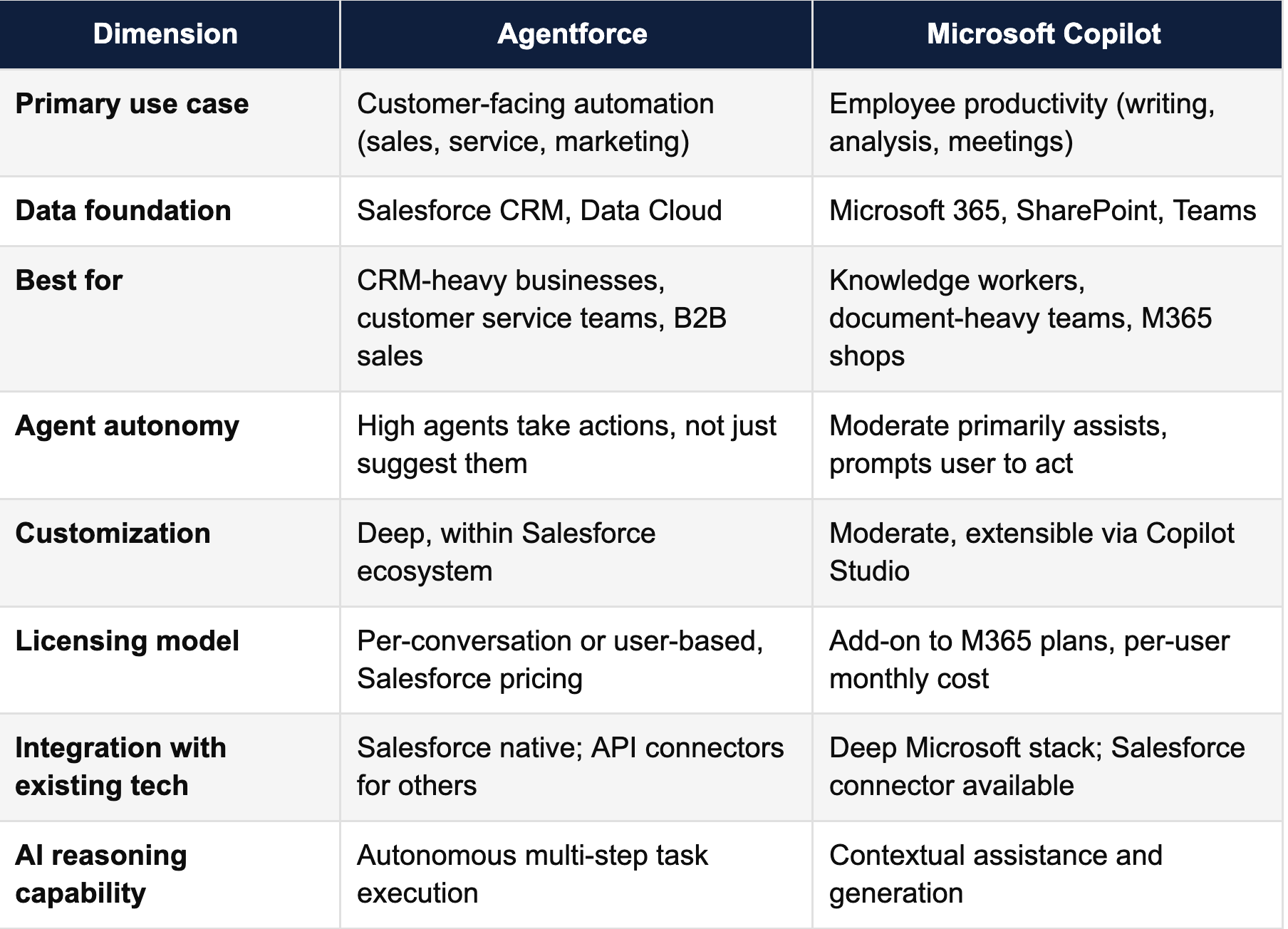
The fundamental distinction between Agentforce and Microsoft Copilot is where they live and what data they operate on.
Agentforce is a customer-facing AI agent platform built on Salesforce. It automates sales, service, and marketing workflows using your CRM data, customer records, opportunity pipelines, case histories, and product catalogs. Its agents act on behalf of your business in customer interactions. Working with a certified Agentforce implementation partner ensures these agents are deployed to fit your actual workflows rather than generic templates.
Microsoft Copilot is an employee-facing AI assistant embedded across Microsoft 365 Word, Excel, Teams, Outlook, and SharePoint. It helps your employees work faster: drafting emails, summarizing meeting notes, analyzing spreadsheets, generating presentations.
These are different categories of AI. One is customer-facing and action-oriented. The other is employee-facing and productivity-oriented. For many US businesses, the honest answer is that you might need both but understanding what each does well is the starting point.
Head-to-Head Comparison
When Agentforce Is the Right Choice
Agentforce makes clear sense when your business meets these conditions:
- You run Salesforce as your primary CRM and your customer data is reasonably well-maintained
- Customer service volume is high and a significant proportion of interactions are routine and repetitive
- Your sales team operates large, complex pipelines and spends too much time on administrative CRM work
- You want AI agents that can take actions in your systems, not just surface information
When Microsoft Copilot Is the Right Choice
Microsoft Copilot fits better when:
- Your team is heavy on document creation, report writing, and knowledge work
- Microsoft 365 is the core productivity suite and SharePoint holds most institutional knowledge
- The primary pain point is employee time-on-task rather than customer interaction volume
- You want meeting summaries, email drafting, and presentation generation for knowledge workers
For care-focused organizations, such as those evaluating Agentforce for senior living, the choice often comes down to whether the priority is internal staff productivity or improving the resident and family communication experience and that distinction maps cleanly onto the Copilot vs. Agentforce decision.
The Case for Running Both
Many mid-market and enterprise US businesses run both Salesforce and Microsoft 365. In that environment, Agentforce and Copilot aren’t competitors they serve different parts of the business.
A practical division of labor might look like this:
- Agentforce handles inbound customer service, lead qualification, and sales process automation in Salesforce
- Copilot supports the internal teams helping account managers draft proposals, summarize deal notes, and prepare customer-facing documentation in Word and Teams
The integration question then becomes about data sharing between Salesforce and Microsoft 365, which is a solvable problem through existing connectors and API configurations. SaasWorx helps businesses across states like Texas navigate exactly this dual-platform setup mapping which workflows belong in each system before any configuration begins.
Cost Considerations for US Businesses
Pricing for both platforms is complex and tied to existing licensing:
- Agentforce pricing is consumption-based at approximately $2 per conversation, with enterprise agreements available at volume. It requires Salesforce Service Cloud or Sales Cloud as a foundation.
- Microsoft Copilot for M365 runs at $30 per user per month as an add-on to existing M365 Business or Enterprise plans. Copilot Studio for custom agents has separate consumption-based pricing.
ROI depends entirely on use case fit. Agentforce ROI is easiest to measure when it deflects service contacts. Copilot ROI requires tracking productivity gains, which is harder to quantify directly.
Frequently Asked Questions
Can Agentforce and Microsoft Copilot be used together?
Yes. Many US businesses use both, applying Agentforce for customer-facing automation in Salesforce and Copilot for internal employee productivity across Microsoft 365. They operate in separate ecosystems but can share data via integrations.
Which platform is more mature and battle-tested?
Both are active and rapidly evolving as of mid-2026. Agentforce builds on Salesforce’s long history of enterprise CRM deployment. Microsoft Copilot benefits from Microsoft’s deep Microsoft 365 integration and Azure AI infrastructure. Neither is nascent technology at this point.
Is Agentforce only useful if you already use Salesforce?
Agentforce is built to run on Salesforce and requires a Salesforce subscription. Companies not currently on Salesforce face a significantly higher total cost of adoption. For non-Salesforce shops, Copilot Studio or third-party agent platforms may be more practical.
Which platform is better for B2B sales teams?
For B2B sales teams running on Salesforce, Agentforce has a clear edge for pipeline management, lead follow-up automation, and deal intelligence. Copilot complements this with proposal writing, meeting prep, and email drafting within Microsoft 365.
Conclusion
Agentforce and Microsoft Copilot are not the same product competing in the same space. Agentforce automates customer-facing workflows using CRM data. Copilot improves employee productivity across the Microsoft stack.
The right choice depends on where your most important data lives, what problem you’re solving, and what your existing technology stack looks like. For Salesforce-centric businesses focused on improving customer operations, Agentforce is the stronger fit. For Microsoft 365-heavy organizations where employee productivity is the priority, Copilot offers more immediate value.
SaasWorx works with US businesses navigating both platforms from enterprise deployments in the northeast as an Agentforce partner in Massachusetts to mid-market companies across the country. If you're evaluating which AI direction fits your Salesforce investment, explore our guides or get in touch to walk through it with our team.