What Is Salesforce Revenue Cloud? (Now Agentforce Revenue Management)


Let’s Work Together
Quick summary
Salesforce Revenue Cloud is now called Agentforce Revenue Management, following a rebrand Salesforce introduced at Dreamforce 2025 and rolled out generally with the Spring ’26 release. It is the same underlying revenue lifecycle platform, covering product catalog, pricing, quoting, contracting, order management, and billing, now built natively on core Salesforce objects and connected directly to Agentforce agents and Data Cloud. The rename does not change existing contracts, but it does signal where Salesforce is putting its product investment: on-platform, AI-native revenue operations rather than the legacy CPQ managed package.
What is Agentforce Revenue Management
Agentforce Revenue Management, formerly known as Salesforce Revenue Cloud, is Salesforce’s platform for managing the full revenue lifecycle: configuring products, pricing deals, generating quotes, managing contracts and approvals, processing orders, and handling billing and revenue recognition, all inside the core Salesforce data model. It helps companies automate quote-to-cash workflows, support complex pricing and hybrid revenue models, and keep sales and finance teams aligned from the first quote through invoice.
If you have seen the name “Revenue Cloud” on older documentation and “Agentforce Revenue Management” on newer pages, you are not misreading anything. Both terms describe the same platform at different points in its naming history.
Why the Name Keeps Changing
This is one of the more confusing parts of evaluating the platform in 2026, so it is worth laying out plainly. The product has gone through several names as Salesforce has evolved both its architecture and its branding strategy:
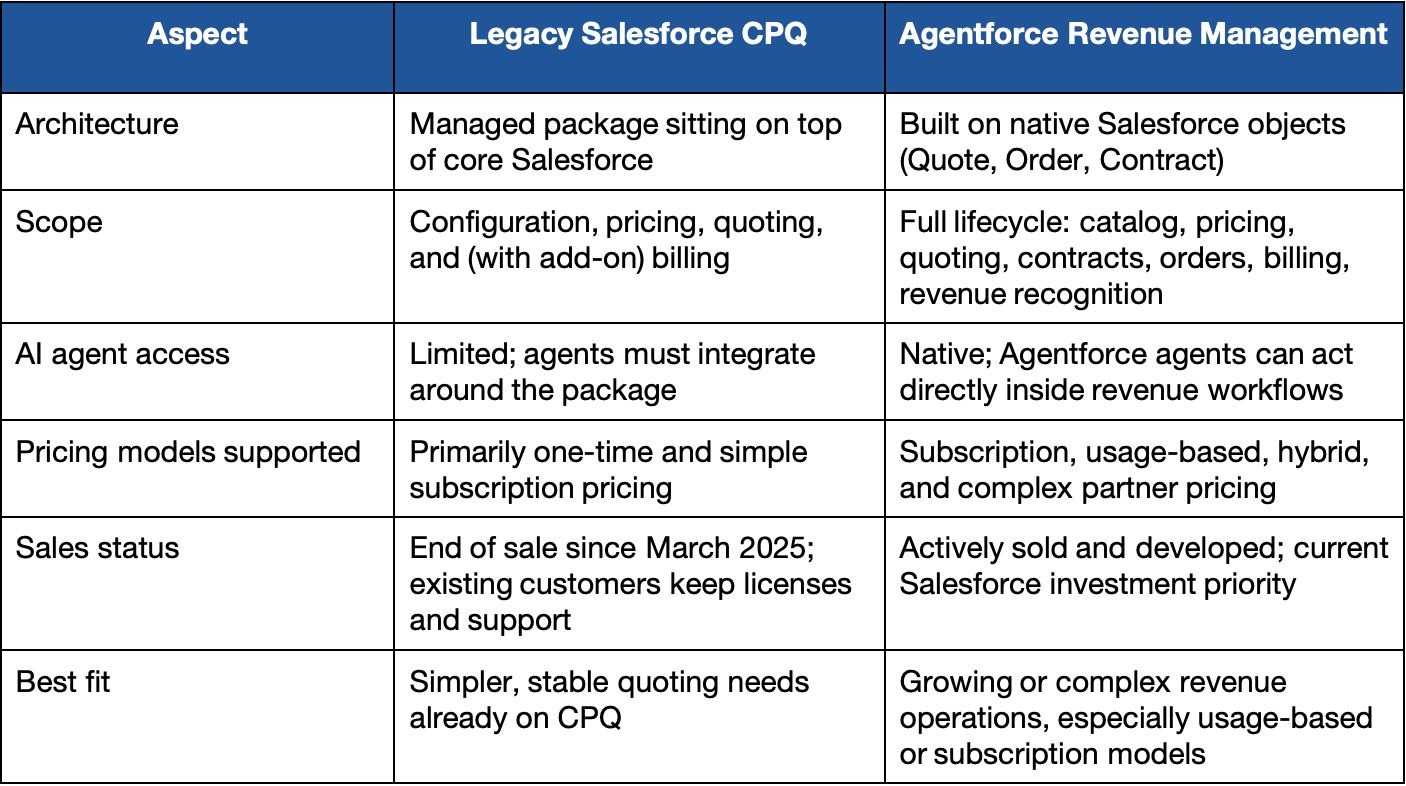
• Salesforce CPQ (originally SteelBrick), acquired by Salesforce in 2015, handled configuration, pricing, and quoting as a managed package sitting on top of core Salesforce
• Revenue Cloud, which bundled CPQ with Billing into a broader quote-to-cash offering
• Revenue Cloud Advanced (RCA), a rebuilt, natively integrated version designed to move revenue processes onto core Salesforce objects instead of a managed package
• Revenue Lifecycle Management (RLM), introduced in Spring ’24 as Salesforce unified the positioning around the full revenue lifecycle rather than just quoting
• Agentforce Revenue Management, the current name, introduced at Dreamforce 2025 and rolled out with the Spring ’26 release (general availability February 23, 2026)
The rename reflects a broader company-wide shift from “Cloud” product names to the “Agentforce” brand, the same change that turned Service Cloud into Agentforce Service and Sales Cloud into Agentforce Sales. It is branding, but it is also a genuine architectural statement: the contract impact for all of these renames is none, so nothing changes commercially for existing customers.
What Changed Beyond the Name
The rename is not purely cosmetic. Two things shifted alongside it that matter for anyone evaluating the platform.
It runs on core Salesforce objects, not a managed package
Agentforce agents run on Salesforce’s core-native object model, meaning standard Quote, Order, and Contract objects, and legacy CPQ sits outside that model as a managed package. This is the practical reason Salesforce has been steering new and upgrading customers toward the newer architecture: an agent cannot reason over or act inside a system it cannot natively query. If your revenue data lives in a managed package with its own object structure, Agentforce’s native agents have a harder time reaching it directly.
It is designed to work with AI agents from day one
Agentforce Revenue Management is the renamed evolution of Salesforce Revenue Cloud and Revenue Cloud Advanced, rebuilt natively with AI agents and broader quote-to-cash capabilities. In practice, this means the platform is built so an Agentforce agent can generate a quote, check pricing approval rules, or flag a billing anomaly as part of an automated workflow, not as a bolt-on integration.
What Agentforce Revenue Management Actually Does
Strip away the branding and the platform covers five connected functions the same ground covered by dedicated Salesforce Revenue Cloud and CPQ implementation services for teams making this move.
1. Product catalog management
A single source of truth for what your company sells, including bundles, subscriptions, usage-based products, and one-time items, structured so pricing and quoting logic can reference it consistently across channels.
2. Pricing and quoting (the CPQ layer)
Configure, price, and quote products with support for discount schedules, approval workflows, and pricing procedures that can vary by customer segment, geography, or deal size. This layer is built for businesses that need more than basic quote or proposal creation: configuring products, applying pricing and discount rules, managing approvals, and generating accurate quotes.
3. Contract and order management
Connect quote terms directly to contracts and convert approved quotes into orders without re-entering data, with support for amendments, renewals, and upgrades as the customer relationship evolves.
4. Billing and revenue recognition
Align invoicing with contract terms and recognize revenue in a way that supports subscription, usage-based, and hybrid commercial models, reducing the manual reconciliation that typically happens between sales and finance systems.
5. Headless and agent-accessible workflows
Its headless capabilities allow companies to expose revenue workflows through APIs, agents, and digital channels, so pricing, quoting, approvals, and billing processes can run wherever customers, sellers, and partners work, not only inside the standard Salesforce UI.
This sits on the same architectural shift covered in Salesforce Headless 360, which exposes the wider platform as APIs, MCP tools and CLI commands so agents can act without ever opening the Salesforce UI.
Who Agentforce Revenue Management Is Built For
The platform is designed for small businesses to enterprise companies with complex product catalogs, subscriptions, usage-based pricing, renewals, partner selling, self-service buying, and governed revenue processes. It is a meaningful step up from lightweight quoting or proposal tools, and it is built to manage the revenue workflow behind the quote, not just the document itself.
That said, it is genuinely overbuilt for very simple sales motions. A company selling a handful of fixed-price products with no subscriptions, no partner channel, and no complex approval chains may find the platform’s depth adds more implementation overhead than it removes. The clearest fit is:
• Mid-market and enterprise companies managing subscriptions or usage-based pricing at scale
• Organizations with multi-channel selling, including direct, partner, and self-service motions
• Companies needing tight alignment between sales quoting and finance’s revenue recognition requirements
• Businesses already investing in Agentforce elsewhere in their Salesforce org, since the revenue and service/sales agents share the same data foundation
This overlaps heavily with what we see across Agentforce for high-tech and SaaS companies specifically, where subscription and usage-based pricing are already the operating norm rather than the exception.
Revenue Cloud vs. Legacy Salesforce CPQ: What’s Actually Different
How Pricing and Licensing Work
Salesforce has moved toward consumption-based and usage-aligned pricing across much of its Agentforce portfolio, and Revenue Management follows a similar direction, layering platform licensing on top of the broader Agentforce 360 packaging. Because Salesforce updates its packaging and pricing structures fairly often, and because enterprise pricing is typically negotiated rather than published as a flat rate, the most reliable approach is to request current pricing directly through your Salesforce account executive or an implementation partner rather than relying on older published figures. What matters more for planning purposes is the total cost of ownership: platform licensing, implementation and configuration, data migration if you are moving off legacy CPQ, and ongoing administration.
Composable by Design: You Do Not Have to Adopt Everything at Once
One detail that gets lost in most overviews of the platform is that Agentforce Revenue Management is composable. Organizations do not need to implement the full lifecycle, from catalog through billing, in a single project. A common adoption pattern looks like this:
1. Start with product catalog and pricing configuration, since this is the foundation everything else depends on.
2. Layer in quoting and approval workflows once the catalog is stable.
3. Connect contract and order management as sales volume and renewal complexity grow.
4. Add billing and revenue recognition capabilities when finance is ready to move off separate billing tooling.
5. Introduce agent-driven automation, such as an agent that drafts renewal quotes or flags pricing exceptions, once the underlying data and workflows are reliable.
This phased approach tends to produce better outcomes than attempting a full lifecycle implementation in one project, particularly for organizations migrating from legacy CPQ where data cleanup alone can be substantial work.
How This Connects to the Rest of Your Salesforce Investment
Because Agentforce Revenue Management is built on the Agentforce 360 Platform, it connects natively with Sales Cloud (now Agentforce Sales) and Service Cloud (now Agentforce Service), along with Data Cloud. For organizations already running Agentforce agents in sales or service, extending that same agent layer into revenue operations, such as an agent that flags a pricing exception before it reaches an approver, or drafts a renewal quote automatically ahead of a contract expiration, is a natural next step rather than a separate project.
Organizations evaluating this path often start by mapping their current CPQ or manual quoting process against what Revenue Management natively supports, then scoping a phased rollout rather than a single big-bang cutover. If you are weighing whether your organization is ready for that shift, SaasWorx’s Salesforce and Agentforce consulting team can help assess your current revenue architecture and map a realistic path forward.
FAQ: Common Questions About Salesforce Revenue Cloud and Agentforce Revenue Management
Is Agentforce Revenue Management the same as Salesforce Revenue Cloud?
Yes. Agentforce Revenue Management is the renamed evolution of Salesforce Revenue Cloud and Revenue Cloud Advanced, rebuilt natively with AI agents and broader quote-to-cash capabilities. Existing Revenue Cloud customers were not required to take any action because of the rename.
Does the rename affect my existing Salesforce contract?
No. Contract impact for all of Salesforce’s 2026 product renames, including this one, is none. Licensing, entitlements, and support terms remain governed by your existing agreement.
Is Agentforce Revenue Management the same product as Salesforce CPQ?
No. Salesforce CPQ is the configuration, pricing, and quoting layer that was later folded into the broader Revenue Cloud (now Agentforce Revenue Management) offering. Revenue Management includes CPQ-equivalent functionality alongside catalog management, contracting, order management, billing, and revenue recognition in one connected platform.
Who should consider moving from Salesforce CPQ to Agentforce Revenue Management?
Companies with subscription pricing, usage-based billing, multi-channel selling, or growing complexity in approvals and revenue recognition are the clearest fit. Businesses with simple, stable, one-time-purchase pricing may not see enough benefit to justify a full re-implementation right away.
Does Agentforce Revenue Management require Data Cloud?
It is designed to integrate closely with Data Cloud and the broader Agentforce 360 Platform, since agent-driven revenue workflows rely on unified customer and product data. Organizations should evaluate their Data Cloud readiness as part of any Revenue Management implementation plan.
Closing Thoughts
The name on the box has changed twice in two years, but the underlying goal has stayed consistent: give revenue teams one connected platform for the entire journey from quote to cash, instead of stitched-together tools that lose data and context at every handoff. What is new in 2026 is that this platform is now built to let AI agents operate inside that workflow directly, which is a meaningfully different architecture than CPQ’s original managed-package design.
If your team is still evaluating what this shift means for your current CPQ setup, our companion guide on migrating from Salesforce CPQ to Agentforce Revenue Management walks through the practical steps.