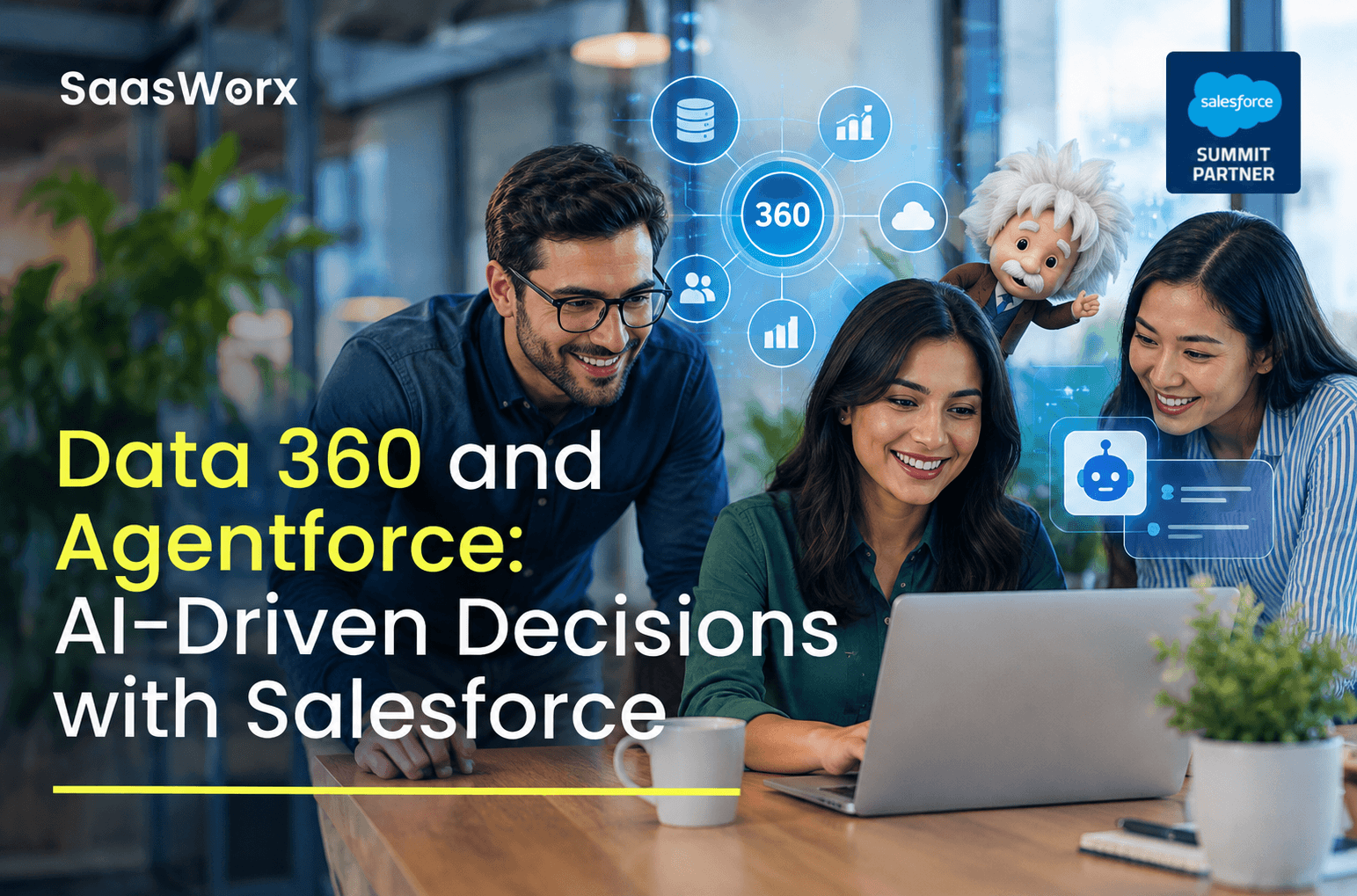
Data 360 and Agentforce: AI-Driven Decisions with Salesforce


Let’s Work Together
Quick Summary
• Data 360 is the current name for Salesforce Data Cloud, renamed on October 14, 2025 at Dreamforce. Same platform, wider remit. It is the real-time data engine that unifies fragmented enterprise data into one trusted customer view.
• Agentforce is the layer that builds, deploys and governs autonomous AI agents. Data 360 is what those agents reason over.
• Without grounding, an agent answers from general knowledge. With Data 360 grounding, it answers from your records, your history and your policies.
• Zero Copy integration connects live data in Snowflake, Databricks, Google BigQuery, AWS and IBM without ETL or duplication. That is usually the fastest route to value for US data teams.
• FedEx unified sales, shipping and web data in Data 360, lifted contract activation from 25% to 40% in five months, and reported over 2,000% ROI.
• Salesforce data shows the average agent now acts on six skills, up from two at the start of 2025, and service agents resolve seven of ten chats without human help.
• Start with one decision, not one dataset. Pick a decision your teams make repeatedly, work backwards to the data it needs, then ground an agent in exactly that.
Most AI agent projects do not fail at the agent. They fail two layers down, in the data.
The pattern repeats often enough to be predictable. A team stands up an agent, demos it beautifully on a clean sandbox, then puts it in front of real customers. The agent gives an answer that is fluent, confident and wrong, because it never saw the open escalation, the renewal date, the credit hold or the last three support tickets. Nobody trusts it after that, which is one of the most common AI implementation challenges US teams run into.
Salesforce built Data 360 to close exactly that gap. This guide covers what Data 360 does, how it grounds Agentforce agents, what changed since the Data Cloud rename, and a sequence US teams can follow without an 18 month data programme in front of them.
What are Data 360 and Agentforce?
Data 360
Salesforce Data 360 is the real-time data engine underneath the Salesforce platform. It unifies fragmented data from every source, including external data lakes, websites and legacy systems, into a single trusted customer profile. Its Zero Copy architecture lets teams act on large data volumes without moving or duplicating them. Salesforce renamed Data Cloud to Data 360 on October 14, 2025. Existing implementations stayed valid. Only the label changed.
Worth knowing if you are searching for documentation: both names are still in circulation. Pricing SKUs and product pages say Data 360, while parts of Trailhead and certification material still say Data Cloud.
Agentforce
Agentforce is not a chatbot. It is the reasoning and execution layer that builds, runs and governs autonomous agents inside Salesforce, and the core of any Agentforce implementation. An Agentforce agent reads context, applies your business rules, and takes action: updating records, triggering flows, escalating cases, completing multi step tasks without a human at every checkpoint.
How they fit together
Think of it as three questions an agent has to answer before it can act.
• What is true right now? Data 360 supplies that. Unified profiles, real-time signals, structured and unstructured content.
• What am I allowed to do about it? Your permissions, sharing rules, consent policies and approval chains supply that, and agents inherit them.
• What should I do? Agentforce supplies that, through reasoning constrained by the instructions and business logic you define.
Remove the first question and the other two collapse. An agent with perfect reasoning and no context is a very articulate guess.
Why grounding is the whole ballgame
Grounding means connecting an agent's responses to your actual data instead of the model's general knowledge. In practice a grounded Agentforce agent uses a retrieval pattern: a search index over your records, a retriever that pulls the relevant pieces, and a prompt template that hands them to the model with the right framing.
That structure matters more than it sounds, because it changes what the agent is doing. It is no longer generating a plausible answer about refunds. It is reading this customer's order, this policy version, this warranty status, and then answering.
Salesforce added Intelligent Context to extend grounding beyond structured records. It extracts and structures information from unstructured sources, including documents, images and tables, so agents can use the material that actually holds your operational knowledge. In most US enterprises that means contracts, service manuals, claim forms and policy PDFs, which is where the useful detail usually hides. For teams rolling out Agentforce for manufacturing, service manuals and warranty records are usually the first place to start.
What Data 360 actually does
The platform breaks into five jobs. Knowing which one your bottleneck sits in saves months.
Connect
• Zero Copy integration with Snowflake, Databricks, Google Cloud and other platforms, with no ETL and no duplication.
• Support for structured and unstructured data: tables, logs, text, images and streaming events.
• More than 200 prebuilt connectors across Salesforce clouds, MuleSoft, databases and third party apps.
Harmonize
• Identity resolution that matches and reconciles customer identities across sources into unified profiles.
• Data prep and transformation tools to cleanse, reshape and enrich before activation.
• A unified data model that maps disparate sources to a standard, extensible structure.
Govern
• Policy based governance that enforces usage rules, consent preferences and compliance requirements automatically, which matters most in regulated sectors such as medical device manufacturing.
• AI tagging and classification to identify sensitive data and apply the right controls.
• Private Connect for secure links between AWS or Azure environments and Data 360, without public internet exposure.
Activate
• Triggered flows that start real-time Salesforce automation from data changes, calculated insights or streaming events.
• Segments built from any harmonized attribute for precise targeting.
• Insights and predictive models covering metrics such as lifetime value, propensity to buy and engagement scores.
Share
• Harmonized profiles, segments and insights pushed back to Snowflake, Databricks, BigQuery and other platforms.
• Activation into downstream business applications and advertising platforms.
Gartner named Salesforce a Leader in Customer Data Platforms for the third year running, which is useful cover when a procurement committee asks why this rather than a general purpose warehouse.
A real example: how FedEx turned data into decisions
FedEx generates roughly a petabyte of operational data a day and had a familiar problem: the signals were there, the ability to act on them was not. Sales teams could see revenue opportunities but needed several IT teams to pull the information together, a process that sometimes took weeks.
One workflow shows the shape of the fix. A small retailer signs a shipping agreement expecting to start on Thursday. Data 360 connects the contract record in Sales Cloud with real-time package scan data from the company's Azure data lake and Databricks environment, then watches the activation window. If no packages move, the account is flagged as dormant, Marketing Cloud sends a personalized reactivation message tied to that contract's specific benefits, and a click-through alerts the assigned rep with full context for a consultative call rather than a generic check in.
The results FedEx reported: activation rates up from 25% to 40% in five months, a 13% improvement in customer activation, over 2,000% ROI, and campaign deployment times down from weeks to minutes. Zero Copy carried a lot of that, with the company accessing Azure data lakes holding four billion rows of shipment records without duplicating any of it.
The lesson for a mid sized US business is not the scale. It is the sequence. FedEx did not unify everything first. They picked decisions that were already being missed, then wired the data those decisions needed.
Zero Copy: Why US data teams pay attention to this one feature
Most enterprises already invested in a warehouse or lakehouse, often a Snowflake AI Data Cloud environment. Telling that team to copy everything into another platform tends to end the conversation. Zero Copy avoids the fight.
• Data stays where it lives, in Snowflake, Databricks, BigQuery, AWS S3 or Redshift, or IBM environments.
• No duplication means no second storage bill and no reconciliation drift between two versions of the truth.
• Governance stays with the source, which shortens security review considerably.
• Agents query current data instead of an overnight snapshot, which is what makes real-time decisions possible.
As FedEx's domain architect put it, zero copy is easier and cheaper than ingesting data again and landing it in multiple places. That is usually the argument that wins internally.
What the 2026 adoption data shows
Salesforce analysed Agentforce usage from February 2025 to April 2026 in its Agentic Enterprise Index. A few findings shape how you should plan.
• The average number of activated agents per organization rose nearly 3x over the fiscal year, and average time from provisioning to first agent creation fell 53%, to around two days. Multi-agent setups are becoming normal too; one of our clients now runs 18 coordinated AI agents for audit orchestration.
• The average agent now acts on six distinct skills, up from two at the start of 2025. Retail agents, like those in our guide to the Agentforce agents every retail business should deploy, reached nine during peak season.
• Service agents resolved seven of every ten customer chats without human help, with escalation rates holding steady at 32% even as volumes climbed.
• Agents increasingly act across cloud domains rather than staying in one, which raises the bar on the underlying data layer.
• Retailers that deployed agents during the holiday season saw a 4x higher sales growth rate, at 8% year over year against 2% without, a strong case for Agentforce in retail and consumer goods.
The direction is consistent. Agents are shifting from generating text to completing work, and the ratio of action calls to output tokens is growing at a 15% compound monthly rate. Actions need reliable inputs. That is why the data layer has moved from an IT concern to a board level one.
Data 360 and Agentforce compared with the build it yourself route
Plenty of teams ask whether they could wire a model to their warehouse and skip the platform. Sometimes the honest answer is yes. Others are weighing one agent platform against another, which we cover in Agentforce vs. Microsoft Copilot. Here is where the difference actually sits.
• Context assembly: a custom stack requires you to build unified profiles and retrieval yourself. Data 360 ships identity resolution, harmonization and search indexes as platform features.
• Governance: a custom stack means rebuilding permissions, field level security, sharing rules and consent handling for the agent. In Salesforce, agents inherit controls your security team already approved.
• Action: a custom stack usually stops at recommendations. Agentforce agents execute inside the workflows and approval chains that already run your business.
• Cost profile: a custom stack carries engineering cost and maintenance. Data 360 carries consumption based credit cost. Neither is free, and which one is cheaper depends entirely on your volume.
• Time to first value: a custom stack is typically measured in quarters. A scoped Agentforce workflow grounded in existing Salesforce data is typically measured in weeks.
The build route makes sense when your decisions barely touch CRM data. If your customers, cases and revenue already live in Salesforce CRM, rebuilding that context elsewhere is expensive work with no differentiation at the end of it.
AI tools and platforms that connect to Data 360 and Agentforce
Search demand around this topic is heavy, so it helps to be specific about what genuinely connects.
• Data platforms via Zero Copy: Snowflake, Databricks, Google BigQuery, Amazon S3 and Redshift, IBM.
• Integration and quality: MuleSoft for API-led connectivity to ERP, field systems and legacy databases, and Informatica for enterprise data management and lineage.
• Analytics and semantics: Tableau for data visualization and for a shared semantic layer that keeps agent answers and dashboard answers consistent.
• Agent surfaces: Slack, Microsoft Teams, WhatsApp, voice, web and mobile, plus MCP compatible clients such as ChatGPT, Claude and Gemini through the Salesforce Headless 360 experience layer.
• Model providers under the AI Trust Layer: OpenAI, Anthropic, Gemini, Meta Llama, Mistral, open source models and Amazon Bedrock.
One practical note. Connecting more tools does not improve answers. Improving the quality and freshness of the two or three sources an agent actually reads does.
Where to start: A practical sequence
1. Pick a decision, not a dataset. Which repeated judgement call is being made slowly, inconsistently or too late? Dormant account follow up. Case triage. Renewal risk, a common starting point for high-tech and SaaS companies. Quote abandonment, which ties directly into Agentforce Revenue Management. Write it down as a decision with an owner and a current baseline.
2. Work backwards to the minimum data. List only what that decision needs. Most teams discover it is four or five sources, not forty. Everything else can wait for phase two, and usually should.
3. Connect before you copy. Check Zero Copy first for anything already in Snowflake, Databricks or BigQuery. Ingest only what genuinely needs to land in Data 360.
4. Resolve identity early. Unified profiles are what turn three partial records into one customer. Skipping this step is the single most common cause of agents giving confidently contradictory answers.
5. Ground the agent narrowly, then test hard. Build the search index, retriever and prompt template against a defined scope. Run scoring evaluations that check whether the agent made the right decision, not merely whether it responded.
6. Instrument, measure against the baseline, then widen. Track completed tasks and outcome movement, not conversation counts. Once one decision improves measurably, the second one takes a fraction of the effort because the foundation is already there.
A realistic first milestone for a US mid market business, whether a senior living operator or a business services firm, is one grounded agent supporting one decision inside a quarter, with the identity resolution and governance pattern reusable afterwards.
Costs and mistakes worth avoiding
Data 360 pricing is consumption based, built around credits, storage and premium add ons, tracked through the Salesforce Digital Wallet. Nearly every Agentforce capability that touches Data 360 consumes credits, so cost planning belongs in the design phase rather than the invoice review.
1. Ingesting everything on principle. Every unnecessary object costs credits, adds noise to retrieval and lengthens your security review. Scope tightly.
2. Treating identity resolution as configuration. It is a business decision about what counts as the same customer. Get the commercial owner in the room.
3. Leaving unstructured content out. If the answer your agent needs lives in a PDF, structured CRM fields will never produce it. Intelligent Context exists for this reason.
4. Grounding without governance. Data 360 policy controls, AI tagging and classification exist so agents do not surface data a user would never have been shown in the UI.
5. Measuring the wrong thing. Conversation volume tells you the agent is busy. Completed tasks and movement in the underlying business metric tell you whether it works.
Frequently asked questions
What is the difference between Data 360 and Data Cloud?
They are the same product. Salesforce renamed Data Cloud to Data 360 on October 14, 2025 as part of the Agentforce 360 announcements at Dreamforce. Existing implementations and contracted capabilities remained valid. You will still see both names across documentation and training material while the transition completes.
Do I need Data 360 to use Agentforce?
For simple agents working entirely within standard Salesforce objects, not always. For agents that need unified profiles, external system data, unstructured content or real-time signals, Data 360 is the practical answer. Most production use cases in the US reach that threshold quickly, usually the first time an agent needs something from a warehouse or a document.
How does Data 360 ground an Agentforce agent?
Through retrieval augmented generation. Data 360 builds a search index over your records and content, a retriever pulls the relevant material at runtime, and a prompt template supplies it to the model with the right framing. The agent answers from your data rather than from general knowledge, and every answer traces back to a source.
Does Zero Copy mean my data never leaves Snowflake or Databricks?
Zero Copy connects directly to live data in those platforms without ETL pipelines or duplication, so you are not maintaining a second copy or reconciling versions. Governance stays with the source system. It is the fastest path to value for teams with an existing warehouse investment and a security team that dislikes data sprawl.
How long does a first Data 360 and Agentforce deployment take?
Data readiness drives the timeline far more than build effort. A narrowly scoped decision using data already in Salesforce or reachable through Zero Copy can go live in weeks. SaasWorx typically gets a first US client agent into production in around five weeks, covering discovery, data connection, grounding, governance and testing.
The short version
Agentforce gets the attention because agents are visible. Data 360 does the work that decides whether those agents are trusted. An agent grounded in unified, current, governed data makes decisions your team can defend. An agent without that makes decisions your team has to check, which removes the point of having it.
The encouraging part is that this no longer requires a multi year data programme. Zero Copy, prebuilt connectors and native grounding have compressed the runway considerably. What has not changed is the discipline: pick one decision, connect the data it needs, prove the outcome, then widen.
SaasWorx works with US organizations on exactly that path, from use case selection and data architecture through agent design, grounding, governance and production support, with 15 plus Agentforce implementations delivered.