Services



Industry
Resources
Company


Summarize this blog post with:
NetSuite and Microsoft Dynamics 365 Business Central are both cloud ERP platforms designed for mid-market businesses, but they differ fundamentally in scope and scalability. Business Central is Microsoft's SMB-focused ERP with strong Microsoft 365 integration and a lower entry cost, making it suitable for businesses up to approximately 100 crore rupees with straightforward single-entity operations. NetSuite is a unified suite covering finance, CRM, inventory, project billing, and e-commerce in one platform with native multi-entity consolidation, making it the stronger choice for businesses scaling across entities, IT/ITES companies needing project billing, and organisations that will outgrow Business Central's scalability ceiling within three to five years.
Microsoft Dynamics 365 Business Central and NetSuite are two of the most frequently compared ERP platforms for growing Indian businesses. Both are cloud-based. Both target the mid-market. Both are credible upgrades from Tally, Zoho Books, or basic accounting software.
But they are built for different trajectories. Business Central is Microsoft's SMB product with lower entry cost, strong Microsoft 365 integration, and simpler implementation. NetSuite is a unified mid-market to enterprise suite with a broader functional scope, native multi-entity consolidation, and a design to scale without replacement.
This guide covers what each platform offers Indian businesses, where each one excels, where each has limitations, and which one fits each growth stage.
The Business Central versus NetSuite question is most common in Indian businesses between 30 crore and 150 crore rupees that are outgrowing Tally or Zoho Books and evaluating their first real ERP. If you are at that inflection point, the NetSuite vs Tally and NetSuite vs Zoho comparisons are also worth reading alongside this one, since they cover the same transition from a different angle. Microsoft's brand recognition and lower entry pricing make Business Central an attractive initial shortlist item. NetSuite's broader scope and multi-entity capabilities become relevant as businesses model their three- to five-year growth trajectory.
The cost of choosing Business Central and migrating to NetSuite two years later when you exceed its scalability ceiling is far higher than the cost difference between the two platforms at the time of initial decision. Getting this right at the 40 crore to 80 crore revenue stage avoids a disruptive re-implementation.
NetSuite is a cloud-native ERP platform owned by Oracle, used by over 40,000 businesses globally. It integrates finance, inventory, CRM, e-commerce, and project management in a single system with no on-premise infrastructure required. The Oracle India localisation module covers GST, e-invoicing (IRN generation), e-way bills and TDS configured and maintained through a certified NetSuite implementation partner. NetSuite's unified data model means all modules share one platform, one interface, and one source of truth.
Microsoft Dynamics 365 Business Central is Microsoft's cloud ERP for small and mid-sized businesses. It covers core financial management, inventory, purchasing, sales order management, and basic project management. Business Central integrates natively with Microsoft 365 (Excel, Outlook, Teams), Power BI, and Power Platform. It is positioned below Dynamics 365 Finance in Microsoft's product hierarchy and is designed for businesses between 20 crore and 100 crore rupees in revenue.
Best fit for Microsoft Dynamics 365 Business Central:
• SMBs between 20 crore and 80 crore rupees with single-entity, single-country operations
• Businesses already using Microsoft 365 (Outlook, Teams, Excel) who want native ERP integration
• Companies moving off Tally or basic accounting software that do not yet need full ERP scope
• Organisations where Power BI is the primary reporting and analytics platform
• Businesses where a Microsoft partner relationship is already in place
Multi-entity support from day one
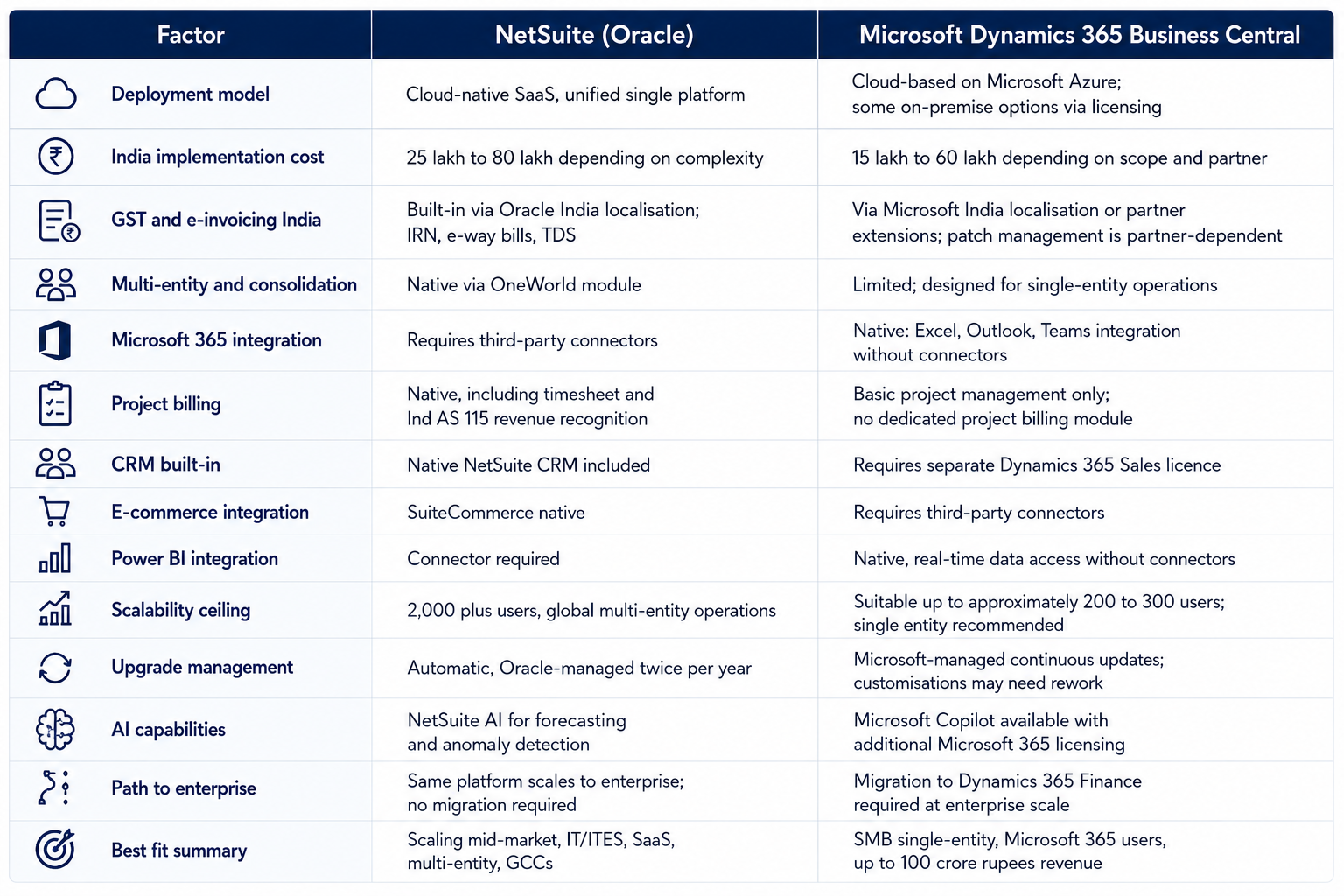
NetSuite's OneWorld module handles multi-entity financial consolidation natively intercompany eliminations, consolidated financial statements, and shared services accounting for any number of entities without custom development. Business Central is designed for single-entity operations. Adding subsidiaries or a holding company structure to Business Central requires significant customisation or migration to Dynamics 365 Finance, a more complex and expensive product.
Project billing and revenue recognition for service businesses
NetSuite includes native project-based billing with timesheet tracking and Ind AS 115-compliant revenue recognition. For IT/ITES firms, SaaS companies, and professional services businesses where project-based billing is core, this is a fundamental requirement that Business Central does not cover without significant additional development or a separate module.
Single unified platform across all functions
In NetSuite, finance, CRM, inventory, and e-commerce share one data model and one interface. The NetSuite integration and automation layer connects third-party systems cleanly when needed, but the core business functions are unified from day one. In Business Central, CRM requires a separate Dynamics 365 Sales licence and integration. E-commerce requires third-party connectors. For businesses that want a genuine single source of truth without a parallel integration project, NetSuite delivers it out of the box.
No platform migration required as you scale
NetSuite grows from 50 users to 2,000 plus without re-implementation. Business Central has a practical scalability ceiling, and businesses that grow beyond it face a migration to Dynamics 365 Finance, a different product with higher cost and a months-long transition. NetSuite eliminates this future migration risk.
Lower entry cost for early-stage mid-market
Business Central's implementation cost of 15 lakh to 60 lakh rupees is lower than NetSuite's typical range of 25 lakh to 80 lakh for comparable functionality at the SMB level. For a 25 crore to 50 crore business with contained, single-entity operations, Business Central covers the functional requirements at lower initial investment.
Native Microsoft 365 integration
Business Central integrates natively with Excel, Outlook, and Teams without connectors. Finance teams can view live ERP data in Excel, process approvals from Outlook, and access key transactions from Teams. These integrations require third-party tools or custom development in NetSuite, adding cost and maintenance overhead for businesses already running Microsoft 365.
Power BI native reporting
Business Central connects to Power BI natively with real-time data access. For businesses where Power BI is the primary analytics and dashboard platform, this is a genuine differentiator. NetSuite's SuiteAnalytics & BI is a capable in-platform reporting engine, but requires an additional connector for Power BI integration.
Familiarity for Microsoft-first teams
Teams already working in Microsoft 365 face a shorter learning curve with Business Central than with NetSuite. For smaller businesses where IT overhead is a constraint and user adoption speed matters, this is a practical advantage.
GST compliance and patch delivery
Both platforms support India GST compliance. NetSuite's compliance patches are Oracle-managed and delivered automatically. Business Central compliance in India is handled through Microsoft's localisation extension or third-party ISV extensions, with patch delivery dependent on the implementation partner. Confirm explicitly how and how quickly your Business Central partner delivers government-mandated compliance updates before signing.
The hidden migration cost for growing businesses
Many Indian businesses implement Business Central at 40 crore rupees in revenue and find themselves planning a migration to Dynamics 365 Finance or NetSuite within three years as they add subsidiaries, outgrow the user ceiling, or need project billing. If your business is approaching the point where its current accounting platform is limiting growth, reviewing the signs your business has outgrown Tally is a useful checklist, the same operational triggers apply when evaluating whether Business Central will last your next growth phase. The cost of migration in consulting fees, data migration, training, and business disruption typically far exceeds the initial saving on Business Central licensing.
Implementation partner quality
Business Central has a wide partner network in India at various price points. NetSuite partners are fewer but more specialised. For both, follow a structured ERP evaluation process and ask for three live references in your industry and size bracket before committing. Partner quality has a greater impact on outcome than platform differences in most Indian mid-market implementations.
If you are still mapping your growth stage to the right platform, the CFO-focused guide on when to move to NetSuite covers the exact signals that make a single-entity SMB ERP the wrong long-term bet.
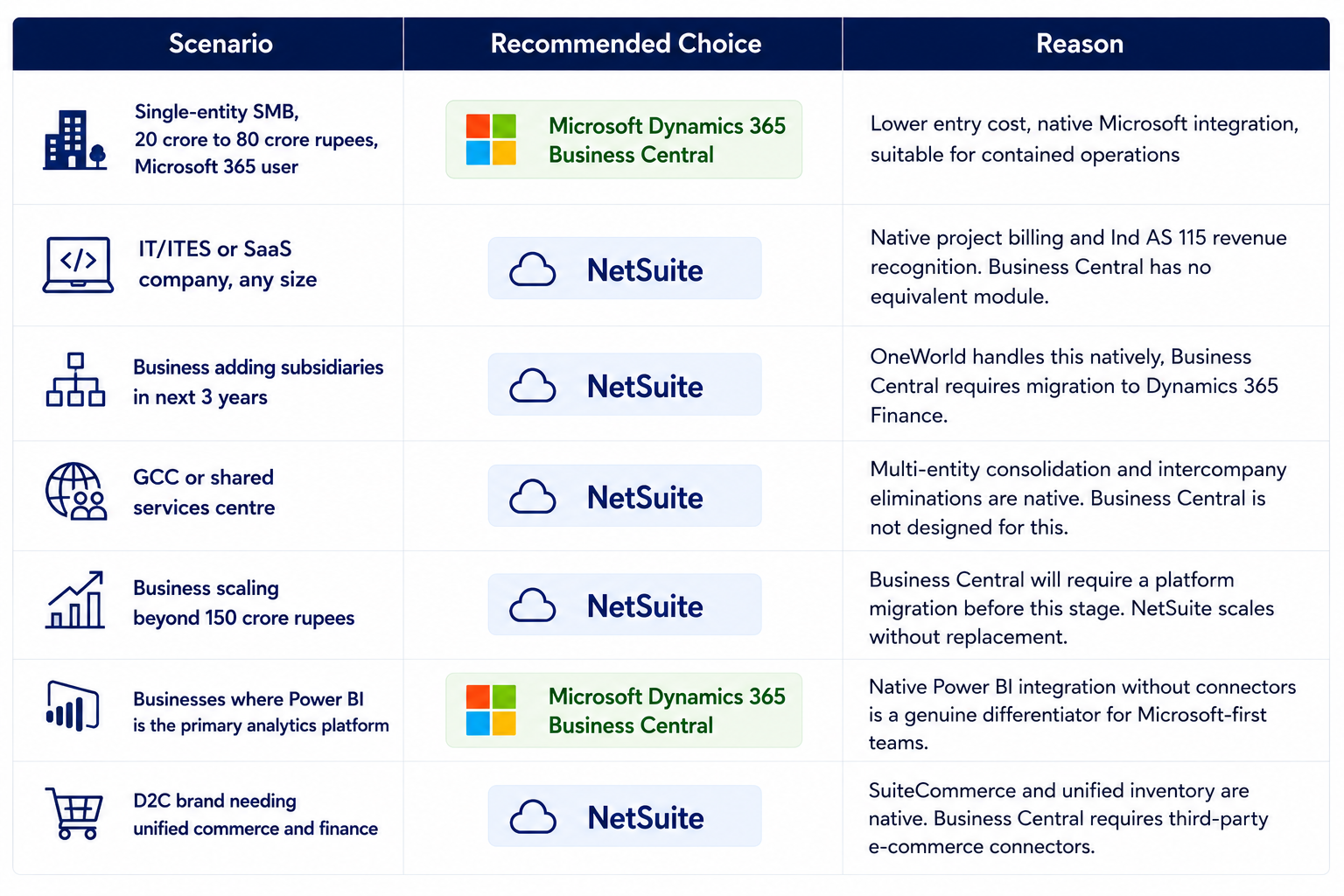
Microsoft Dynamics 365 Business Central is the right starting point for Indian SMBs between 20 crore and 80 crore rupees with single-entity operations who are already running Microsoft 365 and want a lower-cost ERP upgrade from Tally or Zoho Books.
NetSuite is the better long-term investment for businesses that are growing fast, plan to add entities, need project billing, or are already in the 50 crore to 200 crore range with operational complexity that exceeds what Business Central was designed for.
The migration cost from Business Central to a more capable platform when you outgrow it is real and significant. If your three-year trajectory puts you in NetSuite territory, starting there is almost always the more cost-effective decision.
SaasWorx is a certified Oracle NetSuite consulting and end-to-end NetSuite implementation partner with hands-on experience across IT/ITES, SaaS, manufacturing, and professional services businesses in India, UAE, and North America. Whether you are evaluating NetSuite for the first time or have already outgrown Business Central, our NetSuite ERP consulting team evaluates your actual business requirements first and recommends the platform that genuinely fits.
We offer a free 60-minute ERP evaluation consultation with no obligation. We map your processes to the right platform and give you a grounded, India-market recommendation.
Is NetSuite better than Microsoft Dynamics 365 Business Central?
NetSuite is better than Business Central for businesses that need multi-entity consolidation, project billing, native CRM, or a platform that scales without migration. Business Central is better for smaller businesses already in the Microsoft 365 ecosystem who want a lower-cost ERP with native Teams, Outlook, and Power BI integration and have contained single-entity operations.
What is the cost of Microsoft Dynamics 365 Business Central implementation in India?
Microsoft Dynamics 365 Business Central implementation in India typically costs between 15 lakh and 60 lakh rupees depending on the number of users, modules, customisation requirements, and the implementation partner. Annual licensing fees are charged per user per month and are separate from implementation costs.
Can Business Central support multiple entities?
Microsoft Dynamics 365 Business Central has limited multi-entity support and is designed primarily for single-entity operations. Businesses needing multi-subsidiary consolidation, intercompany eliminations, or consolidated reporting across multiple legal entities either require significant customisation or a migration to Dynamics 365 Finance. NetSuite's OneWorld module handles this natively.
Does Business Central support GST in India?
Yes, Microsoft Dynamics 365 Business Central supports GST compliance in India including GSTR-1, GSTR-3B, and e-invoicing through Microsoft's India localisation extension. Unlike NetSuite, Business Central compliance updates are managed by the implementation partner, making partner selection and their compliance update process an important evaluation criterion.
What is the difference between Business Central and NetSuite?
Business Central is Microsoft's SMB-focused ERP with strong Microsoft 365 integration and a lower entry cost. NetSuite is a unified mid-market ERP suite covering finance, CRM, inventory, project billing, and e-commerce in one platform with native multi-entity consolidation. Business Central is suitable for single-entity operations up to approximately 100 crore rupees; NetSuite is designed for businesses scaling beyond that with multi-entity complexity.
Which ERP is better for a company planning international expansion?
NetSuite is significantly stronger for businesses planning international expansion. Its OneWorld module handles multi-currency, multi-tax regime, and multi-entity consolidation natively for cross-border operations. Business Central requires significant customisation or migration to Dynamics 365 Finance for equivalent international capabilities.
When should a business move from Business Central to NetSuite?
A business should consider moving from Business Central to NetSuite when it adds multiple legal entities or subsidiaries, when it needs native project billing or revenue recognition, when it expands internationally, or when it exceeds the user and complexity ceiling that Business Central was designed for, typically around 100 crore to 150 crore rupees in revenue with multi-entity structures.