Services



Industry
Resources
Company


Summarize this blog post with:
Odoo and NetSuite are both ERP platforms, but they are designed for different business stages and operational profiles.
Odoo is an open-source or cloud-based modular platform with a low entry cost and broad functional coverage across HR, CRM, manufacturing, and accounting. It is well-suited for businesses under 50 crore rupees that want operational software at an accessible price point.
NetSuite is a cloud-native enterprise ERP with stronger financial management, multi-entity consolidation, investor-grade reporting, and a more reliable India GST compliance implementation. For growing Indian businesses crossing 50 crore rupees in revenue, adding entities, or raising institutional capital, NetSuite is typically the stronger long-term platform.
Odoo is one of the most frequently evaluated ERP alternatives in the Indian mid-market, particularly among technology-forward businesses drawn to its open-source roots, broad modular coverage, and lower entry price point compared to platforms like NetSuite vs SAP B1 or NetSuite vs Zoho.
The comparison between Odoo and NetSuite is genuinely nuanced. Odoo is not simply a cheaper alternative to NetSuite. It is a different kind of platform, with different strengths, different limitations, and a different total cost of ownership picture than it appears at first glance.
This guide covers what each platform actually delivers for Indian businesses, where each one wins, and what the real-world experience of running Odoo versus NetSuite looks like at scale.
Odoo has grown rapidly in India, particularly among startups, early-stage businesses, and technology companies that adopt it for its low upfront cost and modular flexibility. The question of whether to stay on Odoo or move to NetSuite typically arises at the 30 crore to 80 crore rupees revenue stage, when financial reporting complexity increases, entities are added, or institutional investors start asking questions that Odoo's accounting module was not designed to answer.
India's GST compliance landscape and the rise of e-invoicing mandates have also called into question Odoo's compliance reliability for high-transaction-volume businesses. Getting reliable, timely India GST compliance from Odoo requires careful partner selection and ongoing maintenance that many businesses underestimate when they first implement it.
NetSuite is a cloud-native ERP platform owned by Oracle, used by over 40,000 businesses globally. It integrates finance, inventory, CRM, e-commerce, and project management in a single unified system. NetSuite's Oracle India localisation covers GST, e-invoicing (IRN generation), e-way bills, and TDS natively configured and maintained through a certified NetSuite implementation partner, with patches managed by Oracle automatically.
Best fit for NetSuite:
Odoo is an open-source business software platform headquartered in Belgium. It offers two commercial options: Odoo Community (free, open-source, self-hosted) and Odoo Enterprise (paid subscription, includes cloud hosting and premium features). Odoo's modular suite covers CRM, sales, purchasing, inventory, manufacturing, accounting, HR, e-commerce, and project management across over 30 integrated applications. In India, Odoo is implemented by a wide network of local partners and is widely used across e-commerce, manufacturing, retail, and professional services. India-specific GST compliance in Odoo is handled through the OCA India localisation or partner-developed extensions.
Best fit for Odoo:
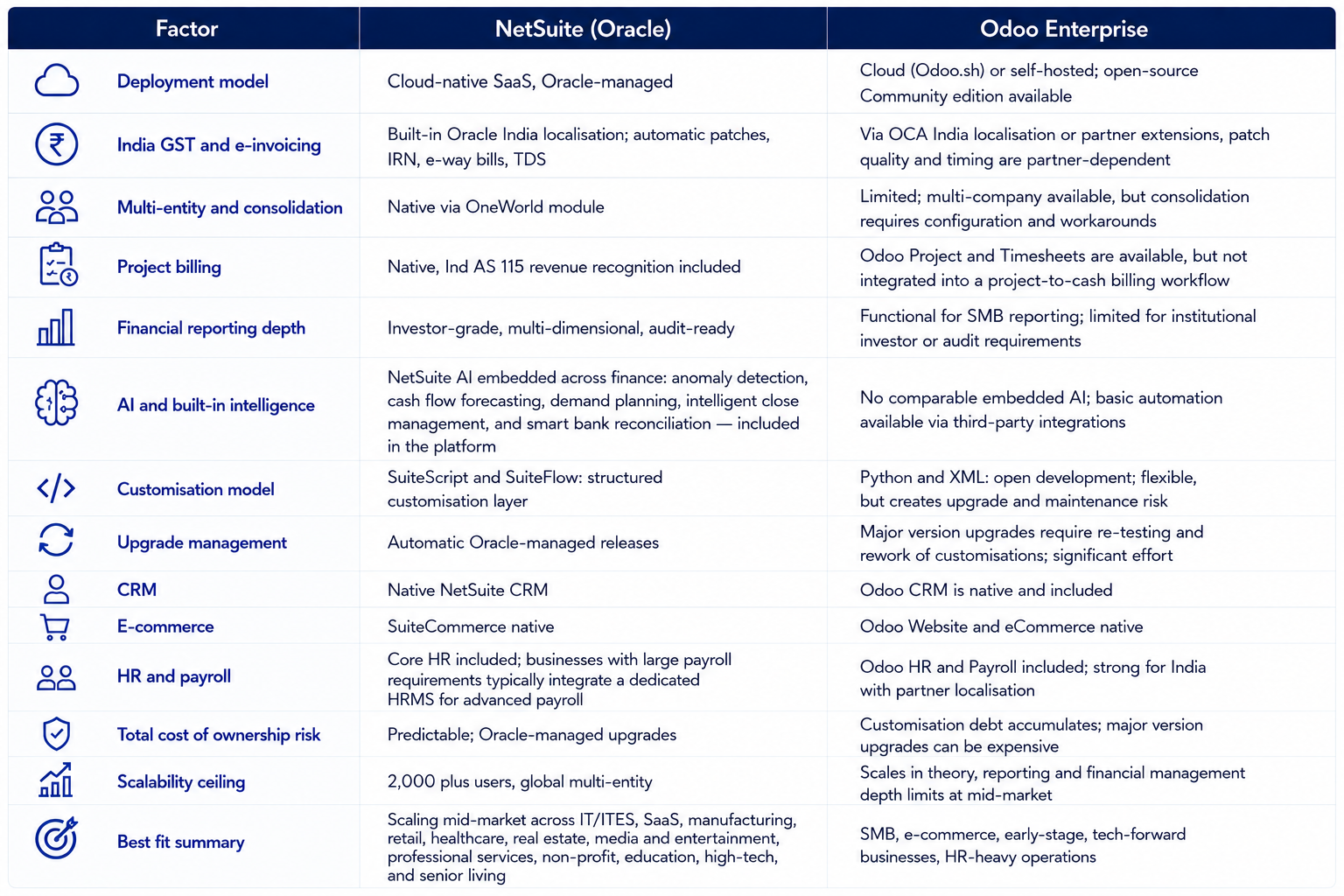
NetSuite produces GAAP and IFRS-compliant financial statements with multi-dimensional reporting across departments, projects, and entities. For businesses that have raised institutional capital or are heading toward a fundraising, NetSuite's financial reporting meets the standards that PE firms, VCs, and audit committees require. Odoo's accounting module produces accurate reports for operational visibility and tax filing but is not designed for the reporting depth institutional investors expect.
NetSuite's OneWorld module handles multi-entity financial consolidation natively intercompany eliminations, consolidated statements, and multi-currency management for any number of entities without workarounds. Odoo's multi-company feature allows transactions across entities but consolidated financial reporting requires configuration that becomes increasingly burdensome as the number of entities grows. For businesses with holding companies, subsidiaries, or international entities, NetSuite's consolidation capability is materially superior.
NetSuite's Oracle India localisation is maintained and patched by Oracle centrally. E-invoicing, IRN generation, GSTR compliance, and TDS management are updated automatically when government requirements change. Odoo's India GST compliance depends on the OCA localisation module or partner-developed extensions and patch timing, quality, and completeness vary significantly by partner. For businesses with high B2B transaction volumes, this reliability difference is operationally important.
NetSuite's AI capabilities are embedded directly in the platform and included in the subscription, with no additional licensing required. This covers intelligent anomaly detection in financial transactions, cash flow forecasting, demand planning and inventory optimisation, smart matching for bank reconciliation, and guided close management. For finance teams across industries, whether in manufacturing, retail, healthcare, or professional services, these capabilities reduce manual review time and improve forecasting accuracy without adding tool complexity or separate AI licensing costs. Odoo has no comparable embedded AI layer; basic automation is available through third-party integrations but does not match the depth or native integration of NetSuite's AI features.
Odoo's low upfront implementation cost is real, but it is not the total cost of ownership. Odoo customisations are developed in Python and accumulate as technical debt. The NetSuite integration and automation architecture is more structured SuiteScript customisations are upgrade-resilient in a way that Odoo's Python modules are not. Major Odoo version upgrades from version 15 to 16 to 17 require re-testing and often rework of customised modules a cost not visible at implementation time but one that compounds over the product lifecycle.
Odoo Enterprise, at 9 to 20 euros per user per month, covers CRM, accounting, inventory, manufacturing, HR, and e-commerce in a single subscription. This is a fraction of NetSuite's licensing cost at a comparable functional scope. For businesses under 30 crore rupees where budget is the primary constraint and operational complexity is limited, Odoo's cost structure is genuinely compelling.
Odoo includes HR, payroll, leave management, and recruitment as native modules. NetSuite's HR capabilities are limited and most NetSuite customers use a separate HR platform. For businesses where HR and payroll integration into the ERP is a priority particularly NetSuite for manufacturing and services companies with large India payrolls, Odoo's HR module is a genuine advantage worth considering before committing to either platform.
Odoo includes a full-featured e-commerce module with a website builder, product catalogue, cart, and checkout integrated with inventory and accounting. For D2C brands and online retailers, this integrated commerce and operations platform is a meaningful advantage over the integration overhead of connecting a separate e-commerce platform to an ERP.
Odoo Community is free and open-source. For businesses with in-house Python development capability, this enables deep customisation without additional licensing costs. NetSuite customisation via SuiteScript requires specialised skills and typically involves a NetSuite partner. For technology companies with developer resources who want maximum flexibility over their ERP, Odoo's open model has real appeal.
India GST compliance is the single most important operational consideration for any ERP in the Indian market. NetSuite's Oracle-managed India localisation is reliable and automatically updated. Odoo's India GST compliance depends on the implementation partner's localisation approach. Some partners implement a robust, well-maintained India module; others use outdated extensions that fall behind on government notifications. Before selecting Odoo for any India operation with significant transaction volume, run a structured ERP evaluation process and validate the partner's specific India GST implementation, their track record on e-invoicing updates, and their responsiveness when government rules change.
One of the most consistent challenges Indian businesses face with Odoo is the accumulation of customisations over time. Odoo implementations typically begin with light customisation and grow significantly as the business adapts the system to local workflows, GST edge cases, reporting requirements, and integration needs. By the time a business is at 50 crore to 80 crore rupees in revenue, its Odoo instance often carries significant technical debt that makes major version upgrades expensive and migration to another platform more complex than expected.
Odoo typically starts showing its limitations for Indian businesses when they add a second legal entity and need consolidated reporting, when they raise Series A or Series B funding and need investor-grade financials, when their transaction volume triggers mandatory e-invoicing and they experience compliance gaps, or when their finance team outgrows Odoo's reporting and starts managing complex reconciliations in Excel. These are the same signals covered in detail in the guide on signs your business has outgrown Tally the triggers are identical regardless of which SMB platform you are currently on.
Evaluating Odoo only on the Year 1 licensing cost. Odoo's customisation and upgrade costs over five years are often higher than the implementation cost difference between Odoo and NetSuite, particularly for businesses that have built significant customisation.
Assuming Odoo's India GST compliance is production-ready without validating the specific partner's localisation approach. GST compliance quality varies widely across Odoo implementations in India.
Choosing Odoo's open-source Community edition for a business without in-house Python development capability. Community is genuinely free but requires developer resources to maintain and upgrade, which most mid-market businesses do not have.
Treating Odoo multi-company as equivalent to NetSuite multi-entity consolidation. Odoo multi-company allows transactions across entities; consolidated financial reporting in Odoo requires workarounds that do not scale well.
Not planning an exit from Odoo before it becomes necessary. Migrating from a heavily customised Odoo instance to NetSuite is more complex and expensive than migrating from a clean one. Understanding what a legacy ERP to NetSuite migration involves and how customisation debt compounds that complexity makes clear why planning the transition early is almost always the more cost-effective decision. If NetSuite is the three-year trajectory, starting migration planning early reduces cost significantly.
If you are close to the transition point and want a CFO-level view, the guide on when to move to NetSuite walks through the exact revenue, entity, and investor reporting signals that tell you Odoo is no longer the right fit for your next phase.
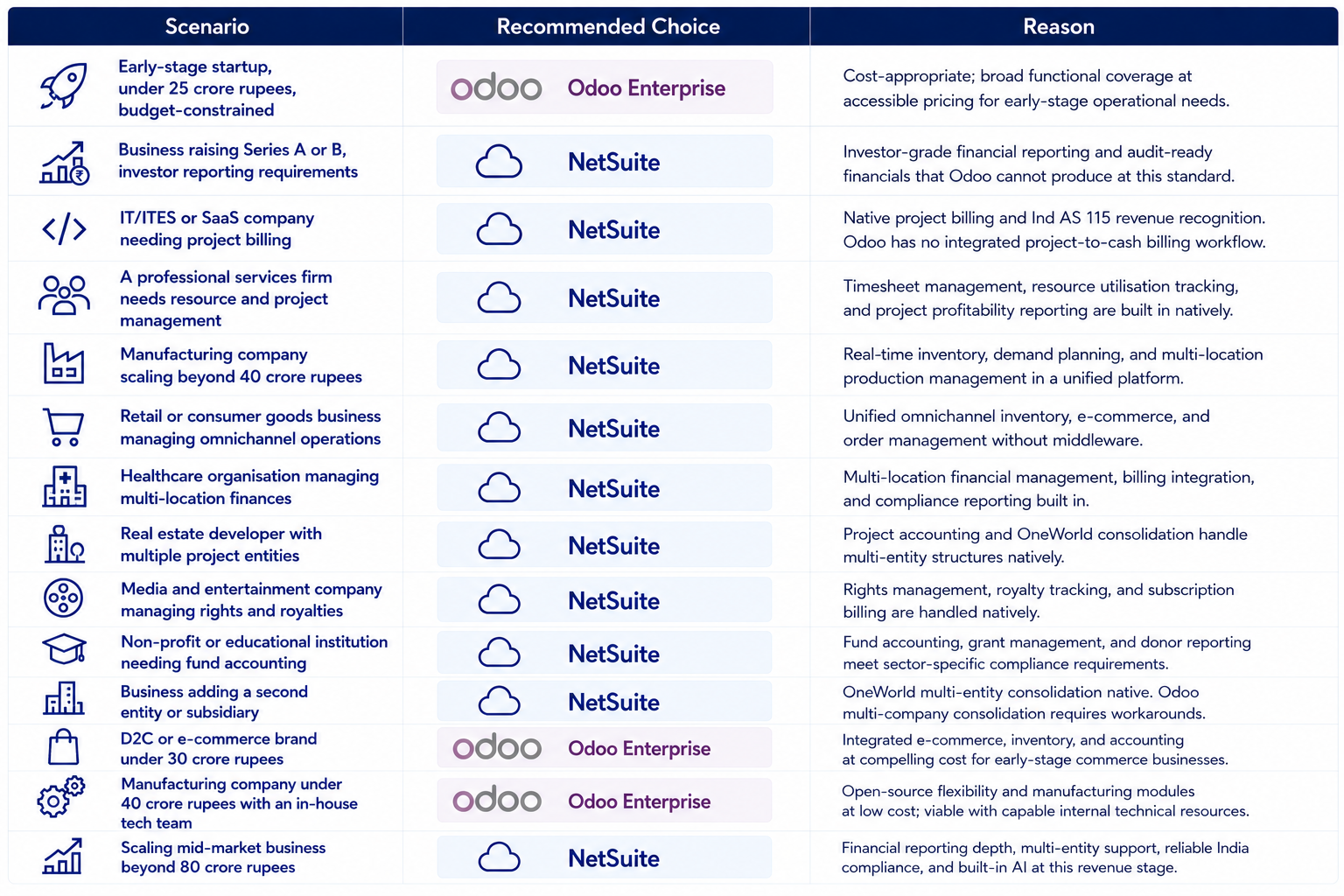
Odoo is a genuinely capable platform for the business stage it was designed for: small businesses and early-stage companies that need broad ERP coverage across HR, CRM, inventory, and accounting at an accessible price point, particularly where in-house technical capability exists to manage customisation.
NetSuite is the stronger choice when a business crosses 50 crore rupees in revenue, adds entities, needs institutional-grade financial reporting, or reaches the point where Odoo's GST compliance reliability, upgrade complexity, or consolidation limitations create real operational friction. NetSuite's built-in AI capabilities, embedded across finance, inventory, and operations, add a further advantage for businesses that want intelligent automation without the overhead of separate tooling.
The most important planning decision for businesses currently on Odoo is to identify their migration horizon early, not to avoid it, but to manage it on their own timeline rather than being forced into a rushed migration by a compliance gap or investor requirement.
SaasWorx is a certified Oracle NetSuite implementation partner with hands-on experience across IT/ITES, SaaS, manufacturing, retail, healthcare, real estate, media and entertainment, professional services, non-profit, education, insurance, high-tech, and senior living businesses in India, the UAE, and North America. We evaluate your actual business requirements first and recommend the platform that genuinely fits.
We offer a free 60-minute ERP evaluation consultation with no obligation. We map your processes to the right platform and give you a grounded, India-market recommendation.
Is Odoo better than NetSuite for Indian businesses?
Odoo is better than NetSuite for small Indian businesses under 30 crore rupees that need broad ERP coverage at low cost and have the technical capability to manage customisation. NetSuite is better for mid-market businesses that need investor-grade financial reporting, reliable Oracle-managed India GST compliance, multi-entity consolidation, built-in AI across finance and operations, or a platform that scales without major version migration risk.
What is the cost of implementing NetSuite or Odoo for my business?
Pricing for both platforms depends on your business size, number of users, modules required, and implementation complexity. Rather than publish figures that may not reflect your specific situation, we recommend a direct conversation. Contact SaasWorx for a free 60-minute ERP evaluation and we will give you an accurate cost assessment based on your actual requirements- no obligation, no generic quotes.
When should a business move from Odoo to NetSuite?
A business should consider moving from Odoo to NetSuite when it crosses 40 crore to 60 crore rupees in revenue, adds a subsidiary or international entity, raises Series A or later institutional capital with investor reporting requirements, experiences India GST compliance gaps, or when Odoo customisation debt makes major version upgrades prohibitively expensive.
Does Odoo support GST in India?
Odoo supports India GST compliance through the OCA India localisation module or partner-developed extensions. Unlike NetSuite, where India GST compliance is managed and patched centrally by Oracle, Odoo's India GST implementation quality depends entirely on the implementation partner. For businesses with high B2B transaction volumes and mandatory e-invoicing, validating your Odoo partner's specific India localisation approach is essential.
What are the limitations of Odoo for mid-market Indian businesses?
Odoo's key limitations for mid-market Indian businesses include limited multi-entity consolidation capability, financial reporting depth insufficient for institutional investor requirements, India GST compliance reliability that is partner-dependent, accumulation of customisation technical debt that makes major version upgrades expensive, no embedded AI for financial intelligence or forecasting, and a practical ceiling on financial management depth as businesses scale beyond 50 crore rupees in revenue.
Is Odoo open source?
Odoo Community Edition is open-source and free to use, licensed under LGPL. Odoo Enterprise is a paid subscription that adds premium features, official cloud hosting, and support. Most mid-market Indian businesses use Odoo Enterprise with local implementation partners. Odoo Community requires in-house Python development capability to implement and maintain, which most businesses without a technical team find impractical.
Can NetSuite replace Odoo?
Yes, NetSuite replaces Odoo for financial management, CRM, inventory, project billing, and India GST compliance. Businesses migrating from Odoo to NetSuite need to plan for data migration from Odoo's database, re-mapping of customised workflows to NetSuite's configuration model, and training for the finance team. Odoo's HR and payroll modules are stronger than NetSuite's core HR and some businesses retain a dedicated HRMS alongside NetSuite post-migration or integrate a specialist India payroll platform.
