Services



Industry
Resources
Company


Summarize this blog post with:
Zoho Books and Zoho One are excellent solutions for small Indian businesses under 25 crore rupees that need GST compliance, basic invoicing, and accounting at low cost.
NetSuite is a full ERP platform designed for mid-market businesses that need multi-entity consolidation, project billing, inventory management, and a scalable system that will not require replacement as the business grows.
The most common signal that a business is ready to move from Zoho to NetSuite is when it crosses 50 crore rupees in revenue, adds a second entity, needs investor-grade financial reporting, or starts feeling the limitations of Zoho's reporting and inventory management capabilities.
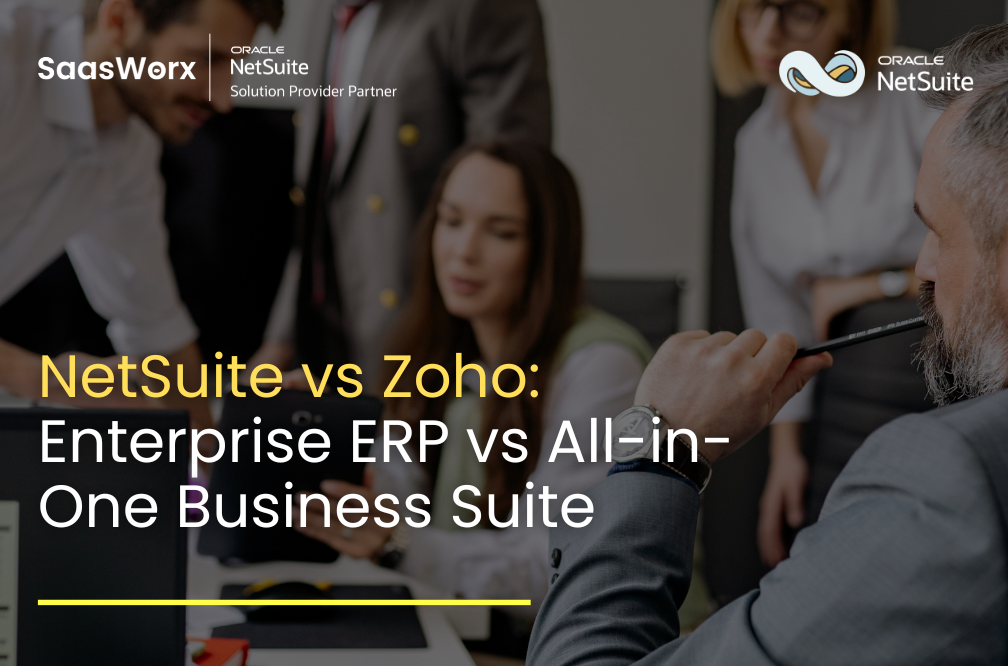
Zoho and NetSuite serve fundamentally different business stages. Zoho Books and Zoho One are built for small businesses and early-stage companies that need solid accounting, GST filing, and basic CRM at an accessible price point. NetSuite is a full ERP platform built for mid-market businesses with real operational complexity.
The comparison matters most for Indian businesses that are currently on Zoho and wondering whether they have outgrown it, or businesses evaluating both platforms before making their first significant ERP investment.
This guide covers what each platform actually does, when Zoho is the right choice, when NetSuite becomes necessary, and the signals that tell you it is time to move.
India's Zoho user base is enormous. Hundreds of thousands of Indian businesses run on Zoho Books or Zoho One. The question of when to move from Zoho to a full ERP comes up regularly for growing companies, particularly those crossing the 30 crore to 50 crore rupees revenue threshold, adding their first subsidiary, or raising institutional capital that comes with investor reporting requirements. Many of these businesses also evaluate NetSuite vs Tally at the same inflection point the operational triggers are often identical.
Getting this timing wrong in either direction is costly. Moving to NetSuite too early means paying for capabilities you do not yet need. Staying on Zoho too long means building workarounds that slow you down and create data quality risks in your financial reporting.
NetSuite is a cloud-native ERP platform owned by Oracle, used by over 40,000 businesses globally. It integrates finance, inventory, CRM, e-commerce, and project management in a single system with no on-premise infrastructure required. The Oracle India localisation module covers GST, e-invoicing (IRN generation), e-way bills, and TDS configured and maintained through a certified NetSuite implementation partner. NetSuite is designed for mid-market businesses with real operational complexity, including multiple entities, inventory at scale, project billing, and investor-grade financial reporting.
Zoho Books is a cloud accounting platform built by Zoho Corporation, a Chennai-based technology company. It handles GST invoicing, expense tracking, bank reconciliation, basic inventory, and direct GSTR filing. Zoho One is a bundle of over 45 Zoho applications, including Zoho Books, Zoho CRM, Zoho Projects, Zoho Inventory, and Zoho Analytics, offered at a per-user subscription price. Both products are built in India for the Indian market and have strong GST compliance out of the box.
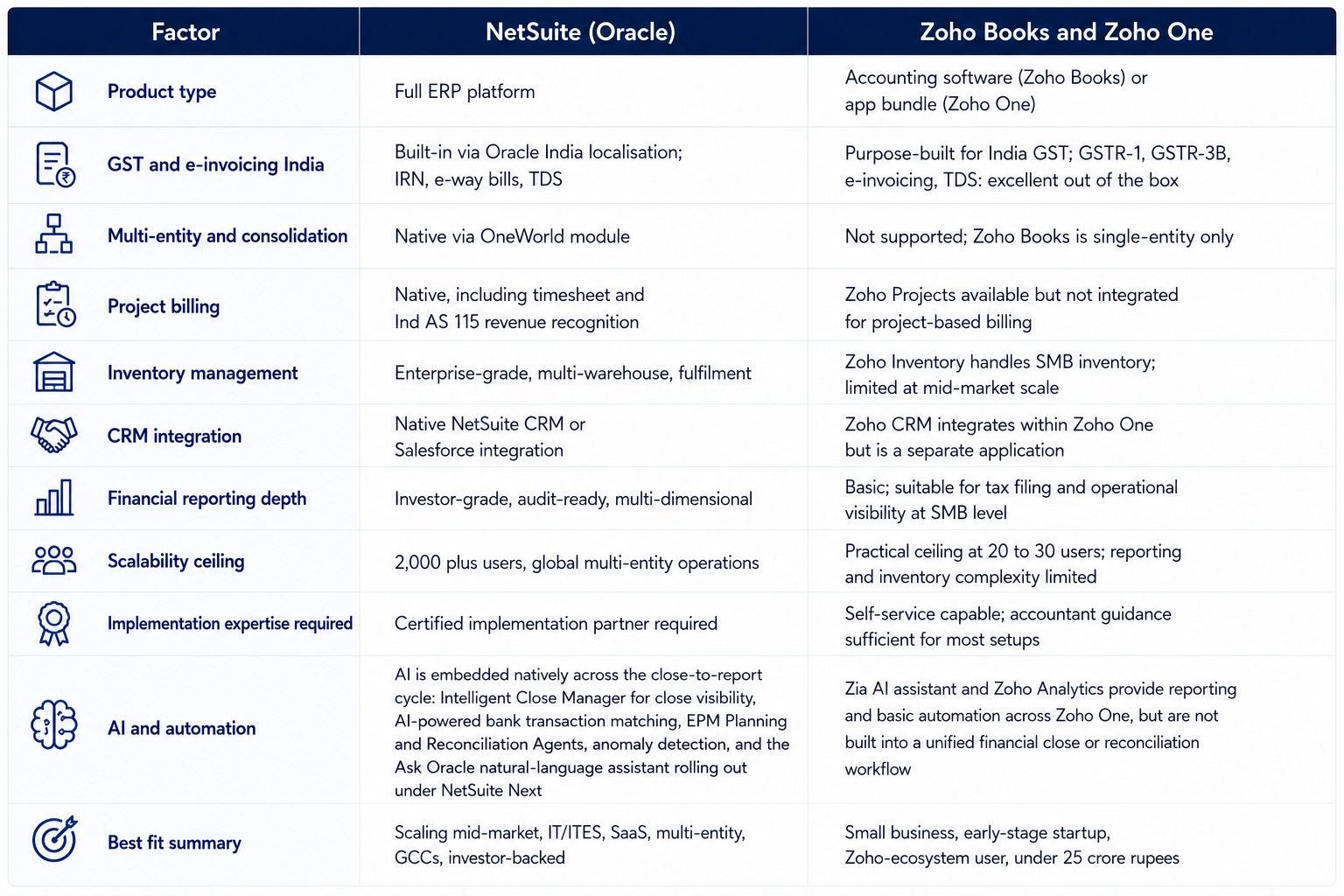
NetSuite handles multi-entity financial consolidation natively via OneWorld intercompany eliminations, consolidated financial statements, and multi-currency management for any number of entities without custom development. Zoho Books is a single-entity product and does not support multi-subsidiary consolidation. Growing businesses that operate through multiple legal entities or holding structures cannot manage this in Zoho Books at all.
NetSuite produces audit-ready financial statements, supports GAAP and IFRS reporting standards, and handles the financial complexity that institutional investors, PE firms, and audit committees require. Zoho Books is designed for SMB-level reporting, which is accurate for tax filing and operational visibility, but not designed for the reporting depth that venture-backed or PE-backed businesses need as they scale.
NetSuite includes native project-based billing with timesheet management and Ind AS 115-compliant revenue recognition, essential for IT services, SaaS, and professional services businesses. Zoho has Zoho Projects and Zoho Books as separate applications but they do not integrate into a unified project-to-invoice-to-revenue-recognition workflow without significant custom development.
NetSuite's inventory module handles multi-warehouse management, demand planning, fulfilment workflows, and landed costs at enterprise scale. Zoho Inventory is a capable SMB tool but hits its limits quickly for businesses managing multiple warehouses, complex fulfilment processes, or significant SKU volumes.
NetSuite's AI in NetSuite capabilities are embedded directly into core finance workflows not bolted on as a separate tool. Intelligent Close Manager gives finance teams real-time visibility into close progress, AI-powered bank transaction matching speeds up reconciliation, and the EPM Planning and Reconciliation Agents support continuous, in-quarter reconciliation rather than a single period-end push. The Ask Oracle natural-language assistant, part of the NetSuite Next rollout through 2026, lets finance and operations teams query business data in plain English instead of building saved searches. Zoho's AI, through Zia and Zoho Analytics, is useful for SMB-level reporting and automation, but it is not built into a single, unified close-and-reconciliation process the way NetSuite's is.
Zoho Books was built in India specifically for Indian businesses. Its GST compliance module is excellent: GSTR-1, GSTR-3B, e-invoicing, TDS, and reconciliation are intuitive and accessible without accounting expertise. For small businesses, this is a genuine advantage over NetSuite, where India GST compliance requires proper configuration by a certified partner.
Zoho Books starts at 899 rupees per month. Zoho One, at approximately 2,800 rupees per user per month, gives access to 45-plus applications. These are accessible price points for early-stage businesses where budget is the primary constraint. NetSuite's annual investment is an order of magnitude higher and is only justified when business complexity warrants it.
Zoho Books and Zoho One are self-service. Most small businesses can set up Zoho Books with accountant guidance in a matter of days. NetSuite requires a certified implementation partner and a structured project typically running three to six months. For businesses that need to move fast and do not have implementation budget or bandwidth, Zoho is the practical choice.
Businesses that have already adopted Zoho CRM, Zoho Desk, Zoho Analytics, and Zoho HR have built operational workflows around the Zoho ecosystem. Moving to NetSuite means replacing those tools or managing integrations between systems, which adds cost and disruption. For businesses where the Zoho ecosystem is working well operationally, the integration continuity of Zoho One is a genuine advantage.
Most Indian businesses are ready for NetSuite when they cross 40 crore to 50 crore rupees in annual revenue, when they add their first subsidiary or international entity, when they raise Series A or B funding and face investor reporting requirements, or when their finance team is spending significant time on manual reconciliation and workarounds in Zoho. Reviewing the signs your business has outgrown Tally is equally useful here — the operational triggers are largely the same whether your current platform is Tally or Zoho. Zoho's limits are not sudden; they show up gradually as reporting requests increase and operational complexity grows.
Some businesses move from Zoho to an intermediate ERP and then re-implement NetSuite a year or two later. This double migration is expensive and disruptive. If a business can see multi-entity structures, institutional investors, or 50 plus crore revenue on the three-year horizon, going directly to NetSuite is almost always the more cost-effective path.
Moving from Zoho to NetSuite requires a certified implementation partner. Data migration from Zoho Books to NetSuite is manageable but requires planning, particularly for open transactions, customer records, and historical reporting periods. Budget three to six months for a standard implementation and factor in change management for the finance team.
Staying on Zoho Books past the point where it can produce the financial reporting your investors, auditors, or board require. The cost of this is not just time: it is financial data quality risk.
Moving to NetSuite too early. A 10 crore rupees startup with simple operations does not need NetSuite. The implementation cost and organisational overhead are disproportionate at that stage.
Trying to extend Zoho Books to do things it was not designed for through customisations and integrations. These workarounds are technical debt that makes the eventual migration to NetSuite more complex.
Not planning the migration of Zoho data carefully. Historical transaction data, customer records, and open AP/AR balances need a structured migration plan. Rushing this creates financial close problems in the first few periods on NetSuite.
Comparing Zoho One and NetSuite as if they are equivalent products. Zoho One is an app bundle that includes accounting software. NetSuite is an ERP platform. They serve different operational maturity levels.
If you are close to the transition point and want a CFO-level view on the decision, the guide on when to move to NetSuite walks through the exact growth signals by revenue, entity structure, and investor reporting requirements that make Zoho the wrong fit for your next phase.
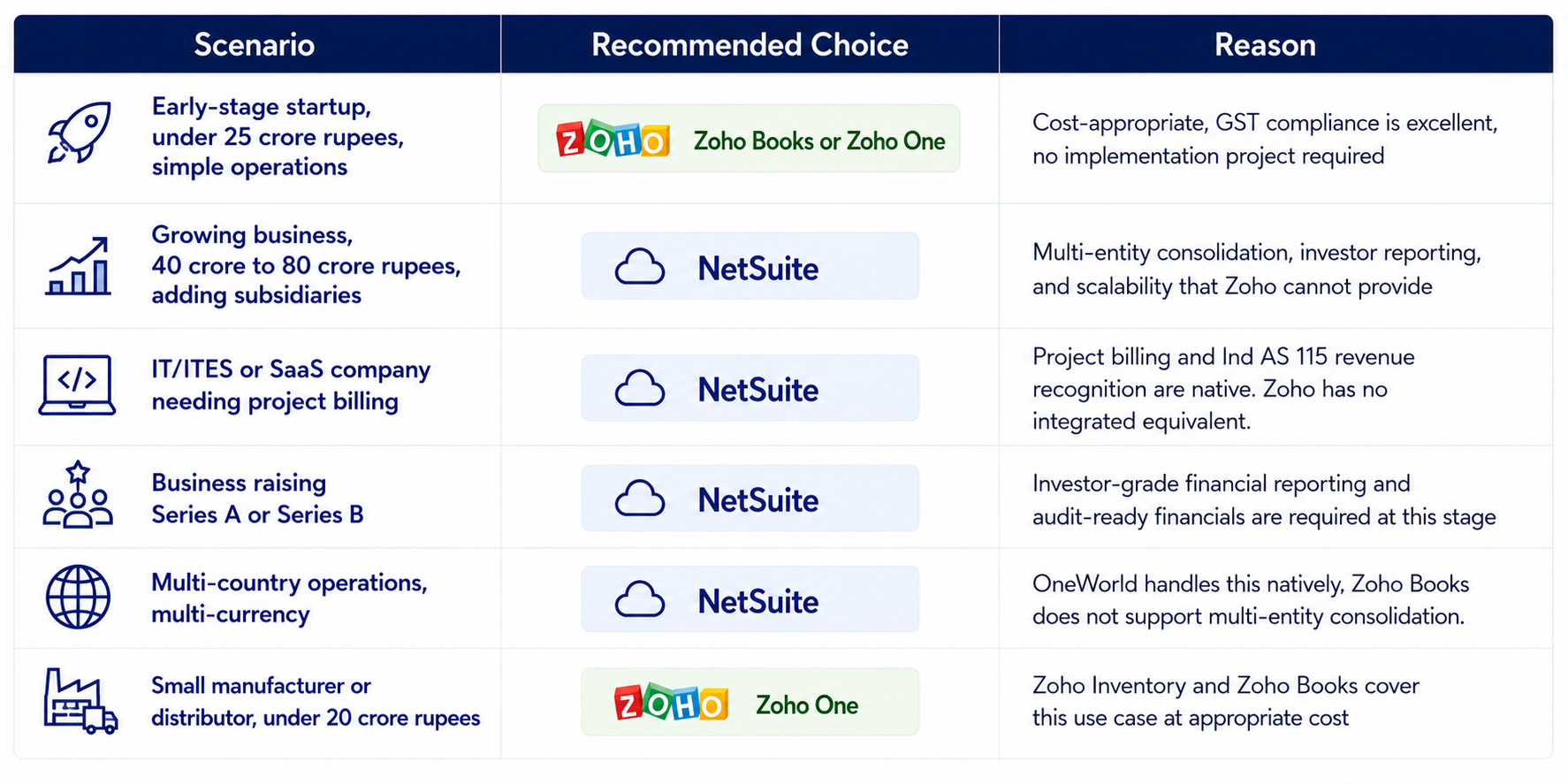
Zoho Books and Zoho One are excellent products for the business stage they were designed for: small Indian businesses under 25 crore rupees that need solid GST compliance, basic accounting, and accessible pricing without the overhead of an ERP implementation.
NetSuite is not the right choice at that stage. But it is almost always the right choice when a business crosses 50 crore rupees in revenue, adds its first subsidiary, takes on institutional investment, or needs the kind of financial reporting and operational visibility that Zoho was not built to provide.
The question is not which platform is better in the abstract. It is which platform is right for the stage you are at now, and whether you are past the point where Zoho is still the honest answer.
SaasWorx is a certified Oracle NetSuite implementation partner with hands-on experience across IT/ITES, SaaS, manufacturing, and professional services businesses in India, UAE, and North America. We evaluate your actual business requirements first and recommend the platform that genuinely fits.
We offer a free 60-minute ERP evaluation consultation with no obligation. We map your processes to the right platform and give you a grounded, India-market recommendation.
Is Zoho better than NetSuite for Indian businesses?
Zoho Books is better than NetSuite for small Indian businesses under 25 crore rupees that need accessible GST compliance, basic accounting, and minimal implementation overhead. NetSuite is better for mid-market businesses that have outgrown Zoho's single-entity scope, need multi-entity consolidation, project billing, or investor-grade financial reporting.
When should a business move from Zoho to NetSuite?
A business should consider moving from Zoho Books to NetSuite when it crosses 40 crore to 50 crore rupees in annual revenue, adds a subsidiary or international entity, raises Series A or later institutional capital with investor reporting requirements, or when its finance team spends significant time reconciling and working around Zoho's reporting limitations.
Can NetSuite replace Zoho?
Yes, NetSuite replaces Zoho Books for accounting, finance management, and GST compliance, and can also replace Zoho CRM, Zoho Inventory, and Zoho Projects with its native modules. The transition requires a certified implementation partner and data migration planning. Businesses that have built extensive workflows in other Zoho apps should evaluate the integration effort before migrating.
What are the limitations of Zoho Books for growing businesses?
Zoho Books' key limitations for growing businesses include no support for multi-entity consolidation, limited financial reporting depth for investor or audit requirements, constrained inventory management for multi-warehouse or high-SKU operations, no integrated project billing, and a practical scalability ceiling that most mid-market businesses encounter between 30 crore and 60 crore rupees in revenue.
Is Zoho One an ERP system?
Zoho One is not an ERP system in the traditional sense. It is a bundle of over 45 business applications including accounting, CRM, HR, and analytics that can be used together. Unlike an ERP like NetSuite, Zoho One applications do not share a single unified data model and require integration between individual apps for cross-functional processes. It covers SMB business operations effectively but does not provide enterprise-grade ERP capabilities.
How long does it take to migrate from Zoho to NetSuite?
Migrating from Zoho Books to NetSuite typically takes three to six months from kick-off to go-live, including data migration, configuration, user training, and parallel running of the two systems. The timeline depends on the complexity of the business, number of entities, integration requirements, and the quality of existing data in Zoho.
Does Zoho Books support multi-entity consolidation?
No, Zoho Books does not support multi-entity consolidation. It is designed for single-entity accounting. Businesses with multiple subsidiaries, holding companies, or international entities cannot consolidate financial statements across entities in Zoho Books. This is one of the most common reasons Indian businesses migrate to NetSuite when they add their second legal entity.