NetSuite vs SAP Business One: The Honest India Guide for 2026



Let’s Work Together
Summarize this blog post with:

NetSuite is a cloud-native ERP built for mid-market and scaling businesses; it handles multi-entity consolidation, project billing, CRM, and e-commerce in a single platform, with automatic GST compliance updates. SAP Business One is better suited for SMB manufacturers and distributors with complex production planning needs who prefer on-premise deployment or have contained single-entity operations. For Indian IT/ITES companies, SaaS businesses, and GCCs scaling beyond ₹50 crore, NetSuite is typically the stronger long-term choice. For manufacturers under ₹80 crore who need deep MRP and BOM management, SAP B1 delivers more out-of-the-box manufacturing depth at a lower entry cost.
Picking between NetSuite and SAP Business One is not a question of which software is better in the abstract. It is a question of which platform fits the specific shape of your business today and which one will still fit three years from now.
Both are credible ERP choices. Both have established partner networks in India. And both will solve many of the same problems on paper. But underneath the brochure language, they are built for different stages, different industries, and different operational profiles.
This guide covers what each platform actually does, where each one wins, where each one struggles in the Indian market specifically, and who should choose what. No forced rankings.
Why This Comparison Matters in India Right Now
SAP Business One has deep roots in the Indian SMB market. Many manufacturers, distributors, and trading companies have been running on it for a decade or more. NetSuite, a cloud ERP platform owned by Oracle since 2016, has been gaining significant ground among IT/ITES companies, SaaS businesses, GCCs, and mid-market firms with multi-entity or cross-border structures.
The SAP B1 vs NetSuite India conversation is most active in the ₹50 crore to ₹200 crore revenue bracket, where businesses start feeling the friction of systems that were not designed to scale with them. GST rule changes, the expansion of e-invoicing mandates, and pressure to produce investor-grade financial reporting have all made the ERP decision more consequential than it was five years ago. Choosing the wrong platform at this stage typically means a painful, expensive re-implementation within three to five years.
What Is NetSuite? (Oracle NetSuite ERP)
NetSuite is a cloud-native enterprise resource planning (ERP) platform built for growing businesses. Owned by Oracle, it integrates finance, inventory, CRM, e-commerce, and project management into a single cloud system with no on-premise infrastructure required. Oracle's India localisation module covers GST, e-invoicing (IRN generation), e-way bills and TDS management, all configured and maintained by a certified NetSuite implementation partner. NetSuite is used by over 40,000 businesses globally across IT/ITES, SaaS, manufacturing, retail, and professional services.
Best fit for NetSuite:
What Is SAP Business One?
SAP Business One (B1) is SAP's ERP product designed for small and medium-sized businesses. Unlike SAP S/4HANA, which targets large enterprises, B1 is built for accessibility and faster implementation. It runs either on-premise or on cloud via SAP HANA. B1's core strength is in manufacturing and distribution; Bill of Materials management, MRP runs, production order tracking, and warehouse management are purpose-built into the product. In India, SAP B1 is used by manufacturers, trading companies, and distributors across industries including auto components, textiles, and FMCG.
Best fit for SAP Business One:
• Manufacturers with complex BOM and MRP requirements
• Distributors and trading companies managing high SKU volumes
• SMBs with 30 to 250 employees looking for structured operational controls
• Companies that require on-premise deployment for data sovereignty or infrastructure reasons
• Businesses already in the SAP ecosystem planning a future move to S/4HANA
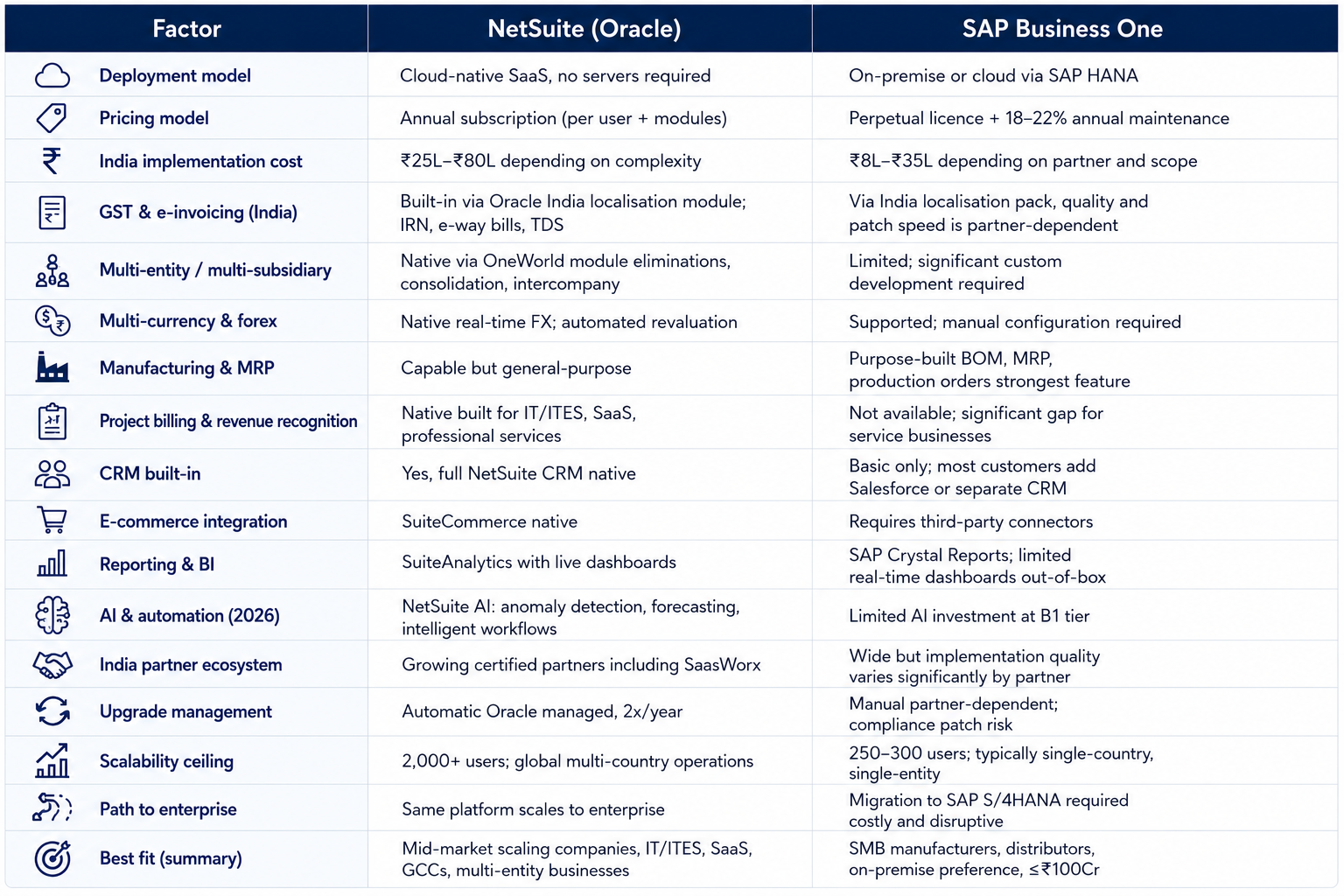
NetSuite vs SAP Business One: Full Comparison Table
Where NetSuite Wins Over SAP Business One
Multi-entity and intercompany operations
NetSuite supports multi-entity consolidation natively via its OneWorld module, handling intercompany eliminations, consolidated financial statements, and shared services accounting without custom development. SAP Business One was not designed for multi-entity operations; extending it to cover multiple legal entities or subsidiaries requires significant custom development and ongoing maintenance effort that compounds over time.
Scalability without platform replacement
NetSuite scales from 50 users to 2,000+ without requiring a platform migration. SAP Business One has a practical ceiling of around 250–300 users and is typically designed for single-country, single-entity operations. Businesses that outgrow B1 must migrate to SAP S/4HANA, a costly, months-long project. With NetSuite, the mid-market to enterprise journey happens on the same platform.
Project billing and revenue recognition for service businesses
NetSuite includes native project-based billing with timesheet management and ASC 606 / Ind AS 115-compliant revenue recognition. This makes it purpose-built for IT/ITES firms, SaaS companies, and professional services businesses where project-based billing is core to the business model. SAP B1 has no equivalent capability; businesses running on B1 typically manage project billing outside the ERP entirely, which defeats the purpose of a unified system.
AI and automation roadmap
Oracle has invested significantly in AI in NetSuite, including anomaly detection in financial transactions, AI-assisted cash flow forecasting, and intelligent automation across AP and AR workflows. SAP Business One sits in a mature-but-limited investment tier from SAP. Businesses thinking about AI-driven finance operations over the next three years will find NetSuite's roadmap materially stronger.
Automatic compliance updates
NetSuite releases two major upgrades per year, managed entirely by Oracle. GST rule changes, revised e-invoicing thresholds, and TDS updates are reflected in platform patches without manual intervention. With SAP B1, compliance updates depend entirely on the implementation partner; patch delivery speed varies, and delays create direct compliance risk in a market where government notification timelines can be short.
Where SAP Business One Wins Over NetSuite
Manufacturing depth: BOM, MRP, and production planning
For businesses with complex production environments, multi-level Bill of Materials, work-in-progress tracking, MRP planning runs, and production order management, SAP Business One delivers more purpose-built specificity than NetSuite. For a broader view of how Indian manufacturers should evaluate ERP platforms, the guide on ERP for manufacturing in India covers the key decision factors across production complexity, inventory, and compliance. NetSuite's manufacturing module is capable but designed as a general-purpose ERP. B1's production planning was built specifically for manufacturers and reflects decades of specialisation in this domain.
On-premise deployment
SAP B1 supports on-premise deployment natively. NetSuite is cloud-only. For businesses that have weighed the cloud vs on-premise ERP trade-offs and have data localisation mandates, government or defence clients with security requirements, or factory operations with unreliable internet connectivity, on-premise is sometimes a genuine hard requirement and B1 is the practical choice when it is.
Lower total cost of entry for contained SMBs
For a 30 to 80 person business with single-entity, single-country operations that are unlikely to change significantly in the next three years, SAP B1's total cost of ownership is typically lower than NetSuite on both licensing and implementation. If the operational requirements stay within B1's scope, it can be the right cost-calibrated choice.
Established India partner depth
SAP B1 has been in the Indian market longer and has a wider network of local implementation partners, including strong coverage in tier-2 cities. For businesses outside Mumbai, Bengaluru, and Delhi/NCR who want on-site implementation support, B1 offers more localised partner options.
India-Specific Considerations
GST, e-invoicing, and TDS compliance
Both platforms cover India's GST compliance requirements. NetSuite's India localisation module handles GSTR-1, GSTR-3B, IRN generation, e-way bills, and TDS. Once implemented correctly by a certified partner, it runs with minimal manual intervention and patches are Oracle-managed. SAP B1 covers the same requirements via its India localisation pack, but compliance patch delivery depends on the partner, confirm explicitly how and how quickly your B1 partner pushes government-mandated updates before signing. If your business is currently on Tally and considering either platform, reviewing the signs your business has outgrown Tally is a useful starting point for understanding what you actually need from a new system.
Implementation partner quality, the most overlooked factor
The implementation partner matters as much as the product choice for Indian businesses. A strong SAP B1 partner will deliver a better outcome than a poor NetSuite implementation and vice versa. Before committing to either platform, ask for three live client references in your industry and revenue bracket. Call those clients directly. This step eliminates the majority of implementation risk.
Five-year total cost of ownership
The software licence is typically only 30–40% of total ERP ownership cost over five years. Training, data migration, customisation, annual compliance patching, and ongoing support make up the remainder. For growing businesses, the cost and disruption of migrating out of SAP B1 when they exceed its scalability ceiling, typically a ₹100–150Cr revenue threshold for multi-entity businesses, should be factored into the Year 1 decision, not treated as a future problem.
Common Mistakes When Choosing Between NetSuite and SAP B1 in India
• Choosing on brand name alone: SAP's global prestige is for S/4HANA, not B1. SAP B1 is the SMB product and carries the constraints of that tier.
• Underestimating the cost of outgrowing SAP B1: Businesses that implement B1 at ₹30 crore and reach ₹150 crore with multiple subsidiaries typically face a forced migration. Understanding what a legacy ERP to NetSuite migration actually involves and what it costs when deferred should be part of the Year 1 decision model.
• Not stress-testing the multi-entity requirement: If your business has any chance of adding subsidiaries, international entities, or a holding structure within five years, validate both systems specifically against that requirement.
• Skipping partner reference checks: Both platforms have strong and weak partners in India. References in your industry bracket are non-negotiable.
• Treating compliance updates as a one-time setup: GST and e-invoicing requirements change regularly. Confirm patch delivery speed and cost for both vendors before committing.
• Optimising for implementation cost, not lifecycle cost: A lower Year 1 SAP B1 quote can cost significantly more over five years if it triggers a forced re-implementation.
Decision Framework: NetSuite vs SAP Business One by Scenario
To understand where your business sits on the growth curve before making this call, the CFO-focused guide on when to move to NetSuite is worth reading alongside this comparison.
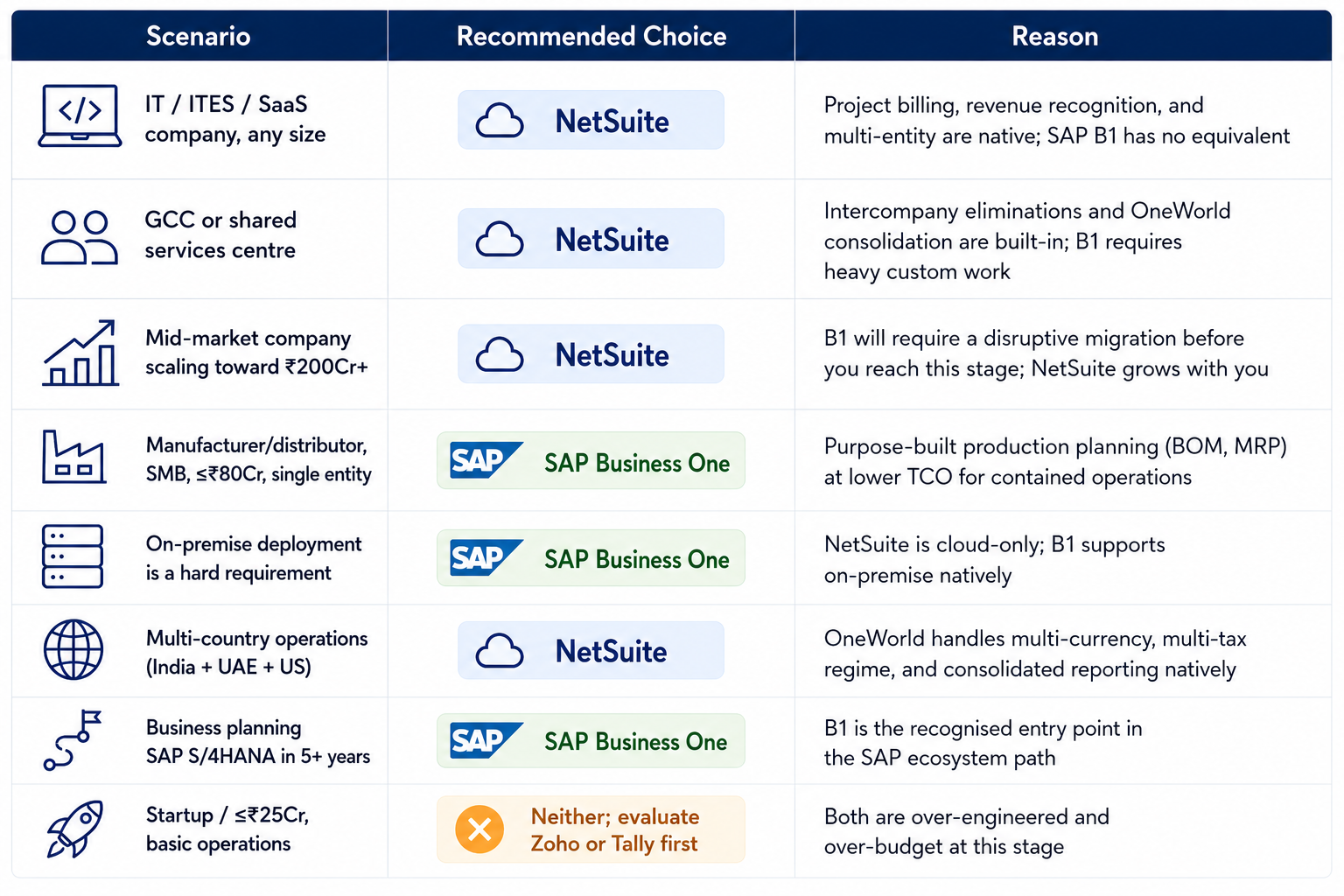
The Bottom Line
SAP Business One is a well-built product for a defined segment SMB manufacturers and distributors with complex production planning needs, single-entity operations, and a preference for on-premise deployment or a future SAP S/4HANA migration path.
NetSuite is built for companies that are growing fast, managing complexity across entities and geographies, and need a unified cloud platform that will not require replacement within five years. For IT/ITES firms, SaaS companies, GCCs, and mid-market businesses in India scaling toward ₹100 crore and beyond, NetSuite is consistently the stronger long-term fit.
The most expensive ERP decision you can make is choosing the right software for the business you are today and the wrong one for the business you will be in three years.
How SaasWorx Can Help
SaasWorx is a certified Oracle NetSuite implementation partner with hands-on experience across IT/ITES, SaaS, manufacturing, and professional services businesses in India, UAE, and North America. We have taken businesses from ₹30 crore single-entity startups to multi-entity GCCs with operations across five countries, all on NetSuite.
We do not recommend NetSuite for every business. If SAP Business One is genuinely the right fit for your stage and operational profile, we will tell you. Our evaluation process starts with your business requirements, not a vendor preference.
We offer a free 60-minute ERP evaluation consultation with no obligation, no sales pressure. We map your actual processes to the right platform and give you a grounded recommendation.
Frequently asked questions
Is SAP Business One better than NetSuite?
SAP Business One is better than NetSuite for SMB manufacturers and distributors who need deep production planning (BOM, MRP) and prefer on-premise deployment within single-entity, single-country operations. NetSuite is the stronger choice for mid-market companies scaling across entities or geographies, IT/ITES and SaaS businesses, and GCCs where multi-entity consolidation, project billing, and cloud-native scalability matter more than manufacturing depth.
What is the cost of SAP Business One in India?
SAP Business One implementation in India typically costs between ₹8 lakh and ₹35 lakh depending on the number of users, modules required, and the implementation partner. Licence costs are separate and carry an annual maintenance fee of approximately 18–22% of the initial licence value. Total five-year ownership cost including support, training, and compliance patching is typically ₹25 lakh to ₹80 lakh for a mid-sized business.
Can NetSuite replace SAP Business One?
Yes, NetSuite can replace SAP Business One and is a common migration path for Indian businesses that have outgrown B1, particularly when they cross ₹100 crore in revenue, add subsidiaries, or expand internationally. NetSuite covers all core SAP B1 functions finance, inventory, purchasing, and reporting and adds native multi-entity consolidation, CRM, project billing, and e-commerce that B1 does not support. SaasWorx has managed SAP B1 to NetSuite migrations for Indian mid-market businesses.
Which ERP is best for manufacturing companies in India?
For SMB manufacturers in India with complex BOM and MRP requirements, SAP Business One offers deeper out-of-the-box production planning capability. For mid-market manufacturers scaling across multiple plants, entities, or geographies, NetSuite is the stronger fit due to its scalability and multi-entity consolidation. Both platforms support GST and e-invoicing through India localisation modules.
Which ERP is best for IT and ITES companies in India?
NetSuite is the leading ERP choice for IT and ITES companies in India. It includes native project billing, timesheet management, and Ind AS 115-compliant revenue recognition, all core requirements for project-based service businesses. SAP Business One does not have equivalent project billing capabilities and is not designed for IT/ITES business models.
Does NetSuite support GST compliance in India?
Yes, NetSuite's India localisation module supports GST compliance, including GSTR-1 and GSTR-3B filing, e-invoicing (IRN generation via the IRP), e-way bill generation, and TDS management. GST compliance updates are delivered by Oracle through its standard release cycle, reducing the risk of falling behind on regulatory changes. Proper configuration by a certified NetSuite implementation partner is required.
What are the limitations of SAP Business One?
SAP Business One's key limitations include a scalability ceiling of approximately 250–300 users, no native support for multi-entity or multi-subsidiary consolidation, limited project billing capabilities, basic CRM, and manual upgrade management that creates compliance patch risk. Businesses with international operations, multiple legal entities, or plans to scale beyond ₹150 crore typically find B1 insufficient and face a disruptive migration to SAP S/4HANA.
How long does a NetSuite implementation take in India?
A standard NetSuite implementation for an Indian mid-market business typically takes 3 to 6 months from kick-off to go-live, depending on the number of modules, data migration complexity, and the degree of customisation required. Businesses with multiple entities, integrations with third-party systems, or complex revenue recognition requirements should plan for the upper end of that range. SaasWorx implementations typically run on a structured 5-phase delivery model.