Services



Industry
Resources
Company



Summarize this blog post with:
Tally and NetSuite are not direct competitors in the traditional sense.
TallyPrime is India's most widely used accounting software, purpose-built for GST compliance, bookkeeping, and statutory reporting for small and mid-sized Indian businesses.
NetSuite is a full cloud ERP platform designed for mid-market businesses with real operational complexity across multiple entities, at-scale inventory management, project billing, and investor-grade financial reporting.
The comparison matters most for Indian businesses that are currently on Tally and hitting its limitations, or businesses evaluating both platforms before their first significant ERP investment. Most Indian businesses outgrow Tally at around 30 crore to 80 crore rupees in revenue, when multi-entity consolidation, investor reporting, or operational complexity exceeds what Tally was built to handle.
Tally is the backbone of Indian business accounting. An estimated 7 million businesses across India run on TallyPrime or Tally ERP 9, making it the most widely used accounting platform in the country. For the business stage it was designed for, Tally is excellent: accurate GST compliance, fast data entry, strong statutory reporting, and a price point that makes it accessible to businesses at every revenue level.
NetSuite is a different kind of product entirely. It is a cloud-native enterprise resource planning platform designed for mid-market businesses that need to manage finance, inventory, CRM, project billing, and multi-entity operations in a single integrated system. The two products are not substitutes at the same stage of the business. Tally is the right answer at one stage; NetSuite becomes the right answer at the next.
This guide covers what each platform actually delivers, the signals that tell you it is time to move from Tally to NetSuite, where Tally remains the honest answer, and how to make this transition without disruption.
The Tally versus NetSuite question comes up in virtually every Indian business that crosses the 30 crore to 50 crore rupees revenue threshold. At that stage, finance teams start running into the same set of limitations: Tally cannot consolidate multiple entities, its inventory management is constrained for complex operations, project billing is not native, and the financial reporting depth required by institutional investors or audit committees is beyond what Tally was designed to produce.
The decision is not purely about revenue. Some businesses at 80 crore rupees are still well-served by Tally because their operations are simple, single-entity, and GST compliance is the primary requirement. Other businesses at 25 crore rupees have already outgrown Tally because they have added a subsidiary, taken on PE investment, or are managing multi-location inventory that Tally cannot handle cleanly. The right move depends on operational complexity, not just the top line.
NetSuite is a cloud-native ERP platform owned by Oracle, used by over 43,000 businesses globally. It integrates finance, inventory, CRM, e-commerce, and project management in a single system with no on-premise infrastructure required. Working with a certified NetSuite implementation partner, the Oracle India localisation module is configured to cover GST, e-invoicing (IRN generation), e-way bills, and TDS natively, with patches managed by Oracle automatically. NetSuite is designed for mid-market businesses with real operational complexity, including multiple entities, inventory at scale, project billing, and investor-grade financial reporting.
Best fit for NetSuite:
TallyPrime (formerly Tally ERP 9) is accounting and business management software developed by Tally Solutions Pvt. Ltd., a Bengaluru-based company. It is the dominant accounting platform in India, used by an estimated 7 million businesses across manufacturing, trading, retail, and services. TallyPrime covers GST invoicing, accounts payable and receivable, bank reconciliation, basic inventory, payroll, TDS, and statutory reports including GSTR-1, GSTR-3B, and e-invoicing. It is deployed as a desktop application with optional cloud access via TallyPrime on Cloud or third-party hosting. TallyPrime is the upgraded version of Tally ERP 9 and includes improved UI, multi-tasking, and enhanced GST features.
Best fit for Tally (TallyPrime):
Multi-entity consolidation for complex holding structures
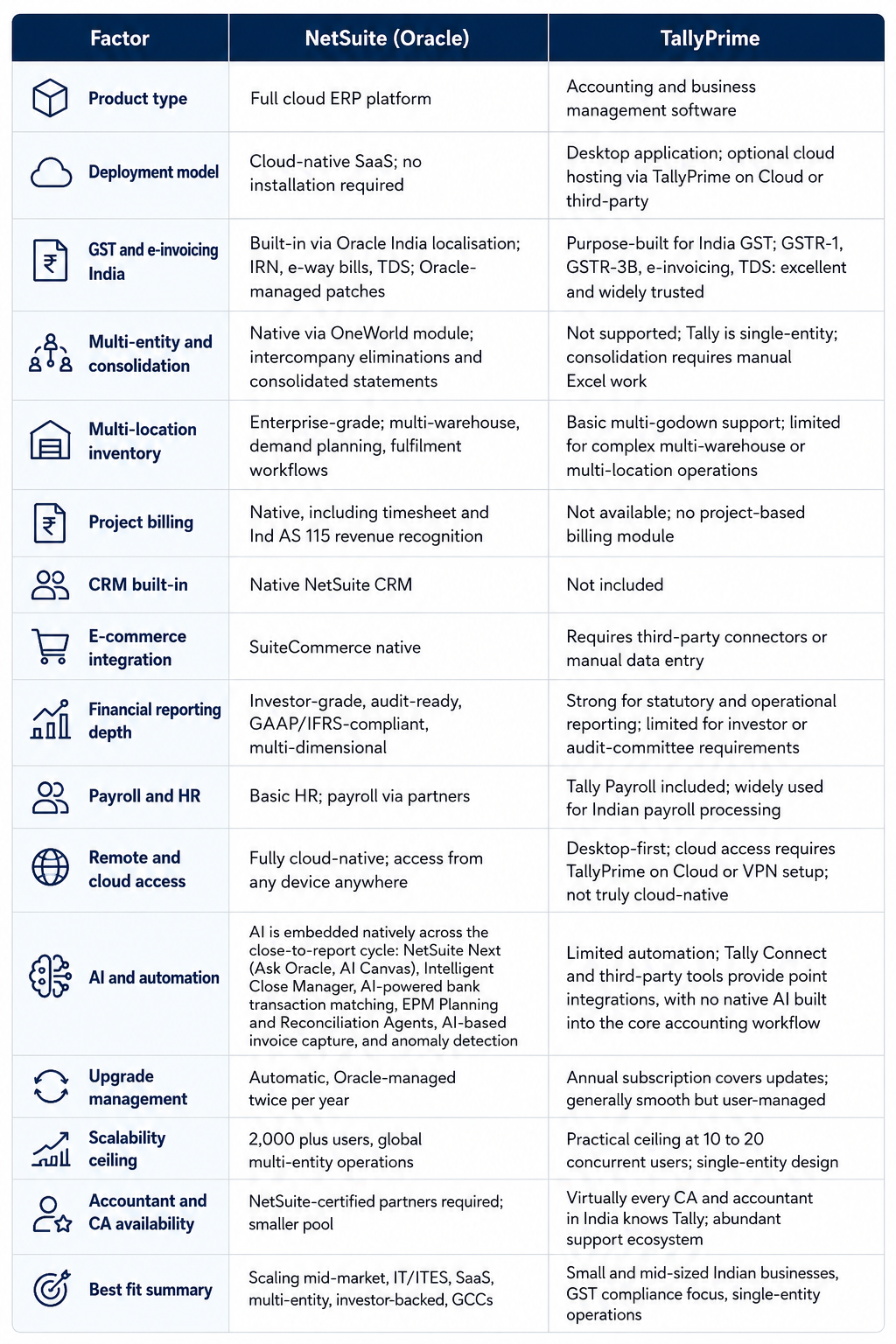
NetSuite's OneWorld module handles intercompany eliminations, consolidated profit and loss statements, consolidated balance sheets, and shared services accounting for any number of entities natively. Tally has no multi-entity consolidation capability. Businesses with a holding company and subsidiaries, or with separate GST registrations across states that require consolidated reporting, cannot do this in Tally without exporting to Excel and doing it manually. For a deeper look at how this works in practice, the guide on multi-entity financial consolidation covers the OneWorld approach in detail. For businesses with even two legal entities, this limitation alone justifies the migration to NetSuite.
Investor-grade financial reporting
NetSuite produces GAAP-compliant and IFRS-compliant financial statements with multi-dimensional reporting across cost centres, departments, projects, and entities. PE firms, VC investors, and institutional lenders require this level of reporting as a standard condition of investment. Tally's reports are excellent for statutory compliance and operational visibility but are not designed for the segmented, audit-ready financial reporting that institutional investors require. Most Tally-based businesses that raise Series A or later funding find themselves rebuilding their reporting infrastructure in parallel — an avoidable cost.
Project billing and revenue recognition for service businesses
NetSuite includes native project-based billing with timesheet management and Ind AS 115-compliant revenue recognition, the two non-negotiable requirements for IT/ITES firms, SaaS companies, and professional services businesses. Tally has no project management or project-based billing module. IT services businesses running on Tally typically manage project billing in separate spreadsheets and import summary figures into Tally, which introduces reconciliation risk and makes revenue recognition manual and audit-prone.
Cloud-native access and real-time visibility
NetSuite is fully cloud-native. Every user, in every location, accesses the same live data from any browser on any device. Tally is a desktop-first application. TallyPrime on Cloud or VPN-based access exists but is not the same as a purpose-built cloud architecture. For businesses with multiple offices, remote finance teams, or leadership that needs real-time dashboards from a phone or browser, NetSuite's cloud architecture is a fundamental operational advantage over Tally's desktop model.
Scalable inventory and supply chain management
NetSuite's inventory module handles multi-warehouse management, bin-level tracking, demand planning, reorder point automation, landed cost allocation, and fulfilment workflows across multiple locations. Tally's inventory management covers basic stock keeping, godown management, and purchase-to-sale workflows, but hits significant limitations for businesses managing multiple warehouses, complex SKU structures, or distribution operations that require real-time stock visibility across locations.
AI-powered financial operations
NetSuite embeds AI directly into core finance workflows instead of offering it as a separate add-on. Intelligent Close Manager gives finance teams real-time visibility into close progress, AI-powered bank transaction matching speeds up reconciliation, and the EPM Planning and Reconciliation Agents support continuous, in-quarter reconciliation rather than a single period-end push. The Ask Oracle natural-language assistant, part of the NetSuite Next rollout through 2026, lets finance and operations teams query business data in plain English instead of building reports manually. Tally has no native AI capability of this kind; automation is largely limited to Tally Connect and third-party add-ons for specific integrations.
GST compliance built for India
TallyPrime was built in India specifically for Indian statutory compliance. Its GST invoicing, GSTR-1 and GSTR-3B filing, e-invoicing (IRN generation), e-way bill generation, and TDS management are deeply integrated, widely tested across millions of Indian businesses, and trusted by virtually every CA in the country. For small businesses, Tally's GST compliance is the gold standard in the Indian market and requires no configuration by a specialist partner.
Familiar local support network
Most accountants and CAs across India are already comfortable working in Tally, and support is generally easy to find even in smaller towns and cities. This familiarity helps small businesses get started quickly without needing specialised training. As businesses scale and move to NetSuite, this gap closes fast: certified NetSuite implementation partners build structured onboarding and end-user training into every project, so finance teams aren't left to figure out the new system on their own.
Total cost of ownership at small business scale
TallyPrime's licence cost starts from approximately 18,000 rupees per year for a single user. For a small business with 2 to 5 accounting users, the total annual cost including support and any customisation is typically under 2 lakh rupees. NetSuite's annual investment is an order of magnitude higher and is only justified when business complexity warrants it. Imposing NetSuite on a 15 crore rupees trading company is over-engineering at high cost.
Fast, familiar data entry for high-volume transaction businesses
Tally's keyboard-driven data entry interface is extremely fast for experienced operators. Businesses processing hundreds of invoices, purchase orders, or payment entries per day run them through Tally with an efficiency that takes time to replicate in any other system. For businesses where the volume and speed of day-to-day transaction processing is the primary operational concern, Tally's interface efficiency is a practical advantage.
Payroll processing for Indian businesses
TallyPrime includes Indian payroll processing covering salary structures, PF, ESI, professional tax, and TDS on salary. For small and mid-sized businesses, this integrated payroll is adequate and removes the need for a separate payroll system. NetSuite's payroll capabilities are limited and most NetSuite customers in India use a separate payroll tool alongside it.
The signals that tell you it is time to move from Tally to NetSuite
There are five clear signs your business has outgrown Tally and is ready for a full ERP platform:
Any one of these signals is a strong indicator that the migration to NetSuite is overdue.
How the Tally to NetSuite migration works
Migrating from Tally to NetSuite is a structured process managed by a certified NetSuite implementation partner. The migration typically covers opening balances from Tally, master data (customer, vendor, and item masters), historical transaction data for the current and prior financial year, and configuration of GST, TDS, and e-invoicing within NetSuite. A typical Tally to NetSuite migration for a mid-market business takes three to five months from kick-off to go-live. Running Tally and NetSuite in parallel for one to two months during go-live is standard practice to ensure data integrity. Plan for change management with the finance team, as Tally-trained accountants need structured training on NetSuite workflows.
The accountant and CA transition
The most common concern Indian businesses raise about moving from Tally is that their CA, their internal accountants, and their auditors all know Tally. This is a real practical consideration, not a dismissible one. NetSuite provides audit trail functionality, GST reports, and export formats that CAs can work with, and most statutory filings continue to be managed through the GST portal directly. However, day-to-day operations will require either retraining existing staff on NetSuite or hiring NetSuite-experienced finance professionals. SaasWorx includes structured end-user training as part of every NetSuite implementation and can support the CA handover process.
If you are still unsure which side of the line your business sits on, a CFO-focused guide on when to switch to NetSuite walks through the decision by growth stage and reporting complexity.
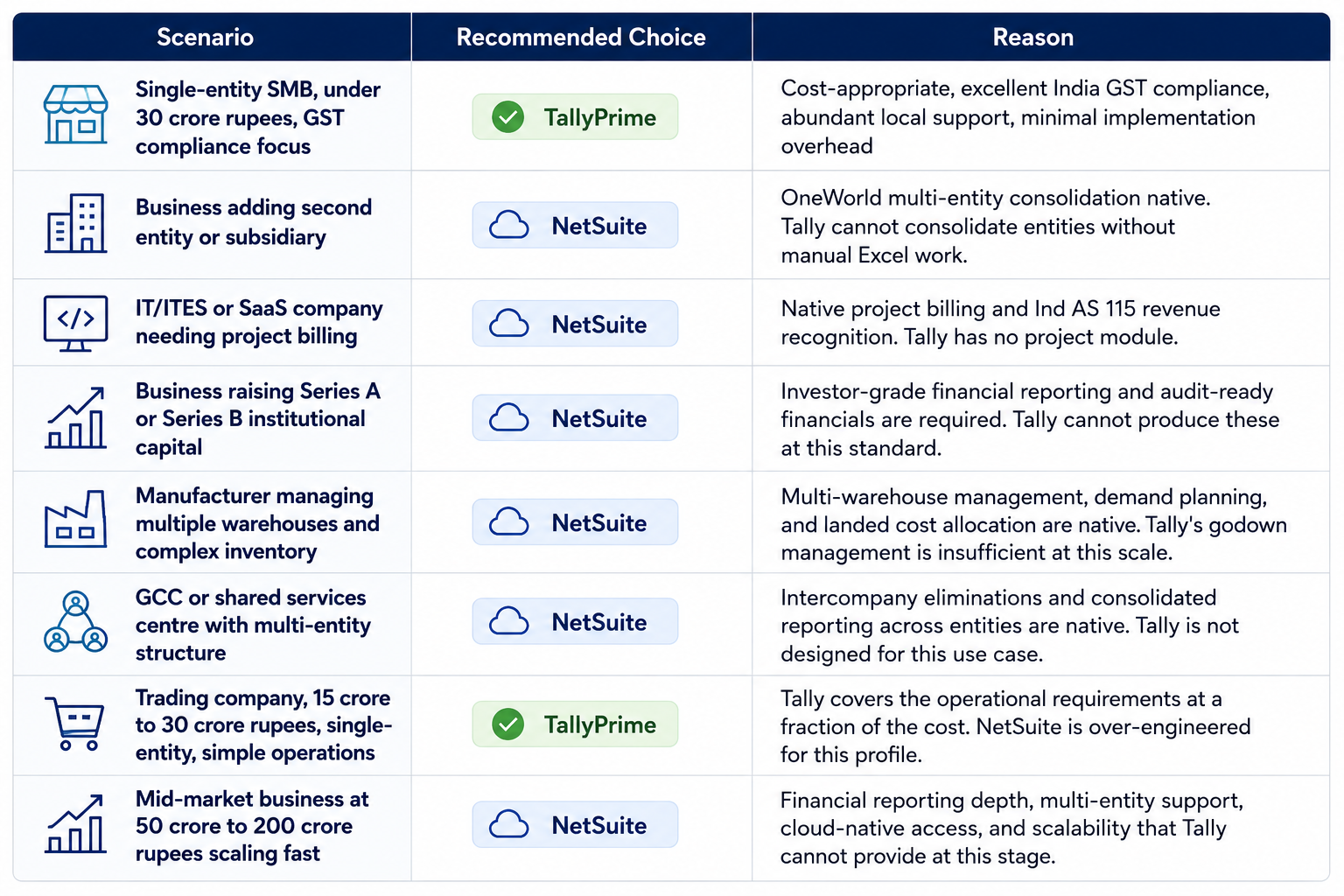
TallyPrime is the right platform for the Indian business it was built for: small and mid-sized businesses that need fast, reliable, India-native GST compliance, straightforward bookkeeping, and statutory reporting at an accessible cost. For this segment, Tally is not just good enough: it is genuinely excellent.
NetSuite is the right platform for the business that has grown beyond what Tally was designed to handle. When a business adds its first subsidiary, raises institutional capital, needs investor-grade reporting, manages multi-location inventory, or runs project-based billing, the cost of staying on Tally is no longer the licence fee: it is the manual reconciliation, the Excel-based reporting, and the credibility risk in front of investors and auditors.
The honest question is not which platform is better in the abstract. It is whether your business has crossed the threshold where Tally's strengths still match your operational requirements, or whether you have grown into the problems that NetSuite was built to solve.
SaasWorx is a certified NetSuite ERP consulting and implementation partner with hands-on experience across IT/ITES, Software & SaaS, Manufacturing, Professional Services, Retail & Consumer Goods, Healthcare, Real Estate, Media & Entertainment, High-Tech, Senior Living, education, insurance, and non-profit businesses in India, UAE, and North America. We evaluate your actual business requirements first and recommend the platform that genuinely fits.
We offer a free 60-minute ERP evaluation consultation with no obligation. We map your processes to the right platform and give you a grounded, India-market recommendation.
Is Tally better than NetSuite for Indian businesses?
TallyPrime is better than NetSuite for small Indian businesses under 30 crore rupees that need fast, reliable India GST compliance, basic bookkeeping, and statutory reporting at low cost. NetSuite is better for mid-market businesses that have outgrown Tally's single-entity design, need multi-entity consolidation, investor-grade financial reporting, project billing, or a cloud-native platform accessible from anywhere without desktop installation.
When should a business move from Tally to NetSuite?
A business should consider moving from Tally to NetSuite when it adds its first subsidiary or second GST entity requiring consolidated reporting, when it raises Series A or later institutional capital with investor reporting requirements, when inventory operations span multiple warehouses beyond Tally's godown management capability, when IT or professional services billing is being tracked in spreadsheets outside Tally, or when the finance team is spending more time exporting and reformatting Tally data in Excel than analysing it.
Can NetSuite replace Tally?
Yes, NetSuite fully replaces Tally for accounting, GST compliance, inventory management, and financial reporting, and adds capabilities that Tally does not have, including multi-entity consolidation, project billing, native CRM, and cloud-native access. The transition requires a certified NetSuite implementation partner and a structured data migration from Tally covering opening balances, master data, and historical transactions.
What are the limitations of Tally for growing businesses?
Tally's key limitations for growing businesses include no support for multi-entity consolidation, financial reporting depth insufficient for institutional investor or audit committee requirements, limited inventory management for multi-warehouse or complex fulfilment operations, no project billing module, desktop-first architecture that limits cloud and mobile access, and a practical scalability ceiling for businesses with complex or multi-location operations.
How long does it take to migrate from Tally to NetSuite?
Migrating from Tally Prime to NetSuite typically takes three to five months from kick-off to go-live for a mid-market Indian business. This includes data migration of opening balances and master data from Tally, GST and TDS configuration, user training, and a parallel run period. The timeline depends on the complexity of the business, number of entities, and the quality of existing data in Tally.
Want to know what NetSuite will cost for your business?
Implementation cost depends on the number of entities, modules, data complexity, and integrations your business needs, so there's no single number that fits every company. Get in touch with us for a free 60-minute assessment, and we'll walk you through a pricing recommendation based on your specific requirements.
Does NetSuite support GST compliance in India as Tally does?
Yes, NetSuite supports India GST compliance, including GSTR-1, GSTR-3B, e-invoicing (IRN generation), e-way bills, and TDS through its Oracle India localisation module. Unlike Tally, which was purpose-built for India GST from the ground up, NetSuite's India compliance requires proper configuration by a certified implementation partner. Once configured, compliance patches are managed automatically by Oracle, reducing the risk of falling behind on regulatory changes.
Is TallyPrime a cloud-based software?
TallyPrime is primarily a desktop application. Cloud access is available through TallyPrime on Cloud (Tally Solutions' hosted offering) or third-party hosting providers, but it is not a cloud-native application in the same way that NetSuite is. NetSuite is fully browser-based and cloud-native, accessible from any device anywhere without installation or VPN. For businesses that need genuine cloud access across multiple locations and devices, NetSuite's cloud architecture is materially superior to Tally's desktop-first model.