Services


Industry
Resources
Company


Summarize this blog post with:
NetSuite and Microsoft Dynamics 365 are both cloud ERP platforms, but they serve different business profiles. NetSuite is a unified suite covering finance, inventory, CRM, and e-commerce in one platform with native multi-entity consolidation, making it the stronger choice for IT/ITES companies, SaaS businesses, manufacturing firms, professional services organisations, retail businesses, healthcare providers, media companies, real estate developers, and mid-market firms scaling across entities. Microsoft Dynamics 365 is modular, deeply integrated with the Microsoft ecosystem including Azure, Teams, Power BI, and Copilot, and the natural choice for businesses already standardised on Microsoft tools. For Indian businesses scaling beyond 100 crore rupees with multiple entities, NetSuite typically delivers lower total complexity. For enterprises already running Microsoft 365, SharePoint, and Azure, Dynamics 365 reduces integration overhead significantly.
NetSuite and Microsoft Dynamics 365 are the two cloud ERP platforms that come up most often in Indian mid-market boardrooms. Both are credible. Both are enterprise-grade. But they represent fundamentally different product philosophies and choosing the wrong one for your business model adds years of avoidable friction.
NetSuite is a unified suite. Every module, including finance, CRM, inventory, e-commerce, and project billing, is built on one data model. Microsoft Dynamics 365 is modular. You assemble the platform from components such as Finance, Sales, Supply Chain, and Business Central and connect them within the Microsoft ecosystem.
This guide covers what each platform actually delivers for Indian businesses, where each one wins, where each one has limitations in the India context, and who should choose what.
The NetSuite versus Dynamics 365 conversation in India is most active among a wide range of growing businesses: IT/ITES companies post-Series B, mid-market manufacturers and distributors looking to move off NetSuite vs Tally or NetSuite vs SAP B1, professional services firms needing project-based billing, retail and consumer goods companies scaling omnichannel operations, healthcare organisations managing multi-location finances, real estate developers managing project accounting, media and entertainment businesses handling rights and royalty management, SaaS companies needing subscription revenue recognition, and educational institutions outgrowing basic accounting tools.
Microsoft's investments in Copilot AI across Dynamics 365 have added a new dimension to the comparison since 2025, particularly for businesses where the broader Microsoft stack is already embedded.
GST compliance, multi-entity reporting, and investor-grade financial close processes have all raised the stakes on ERP selection. Getting this decision wrong at the 50 crore to 200 crore revenue stage typically results in a disruptive re-implementation within four years.
NetSuite is a cloud-native ERP platform owned by Oracle, used by over 40,000 businesses globally. It integrates finance, inventory, CRM, e-commerce, and project management into a single system with no on-premise infrastructure required. The Oracle India localisation module covers GST, e-invoicing (IRN generation), e-way bills, and TDS configured and maintained through a certified NetSuite implementation partner. NetSuite is purpose-built as a unified suite, meaning all modules share one data model and one interface.
NetSuite also includes built-in AI capabilities for financial anomaly detection, demand forecasting, cash flow prediction, and intelligent close management embedded directly in the platform without requiring separate licensing or third-party tools.
Best fit for NetSuite:
Microsoft Dynamics 365 is a cloud-based suite of modular business applications owned by Microsoft. It includes Dynamics 365 Finance (large enterprise), Dynamics 365 Business Central (SMB and mid-market), Dynamics 365 Sales (CRM), and Dynamics 365 Supply Chain Management. These modules can be licensed individually or in combination. Dynamics 365 integrates natively with Microsoft Azure, Microsoft 365 (Teams, Outlook, SharePoint), Power BI, and the Microsoft Copilot AI layer. In India, Business Central and Finance are the most commonly evaluated modules for mid-market businesses.
Best fit for Microsoft Dynamics 365:
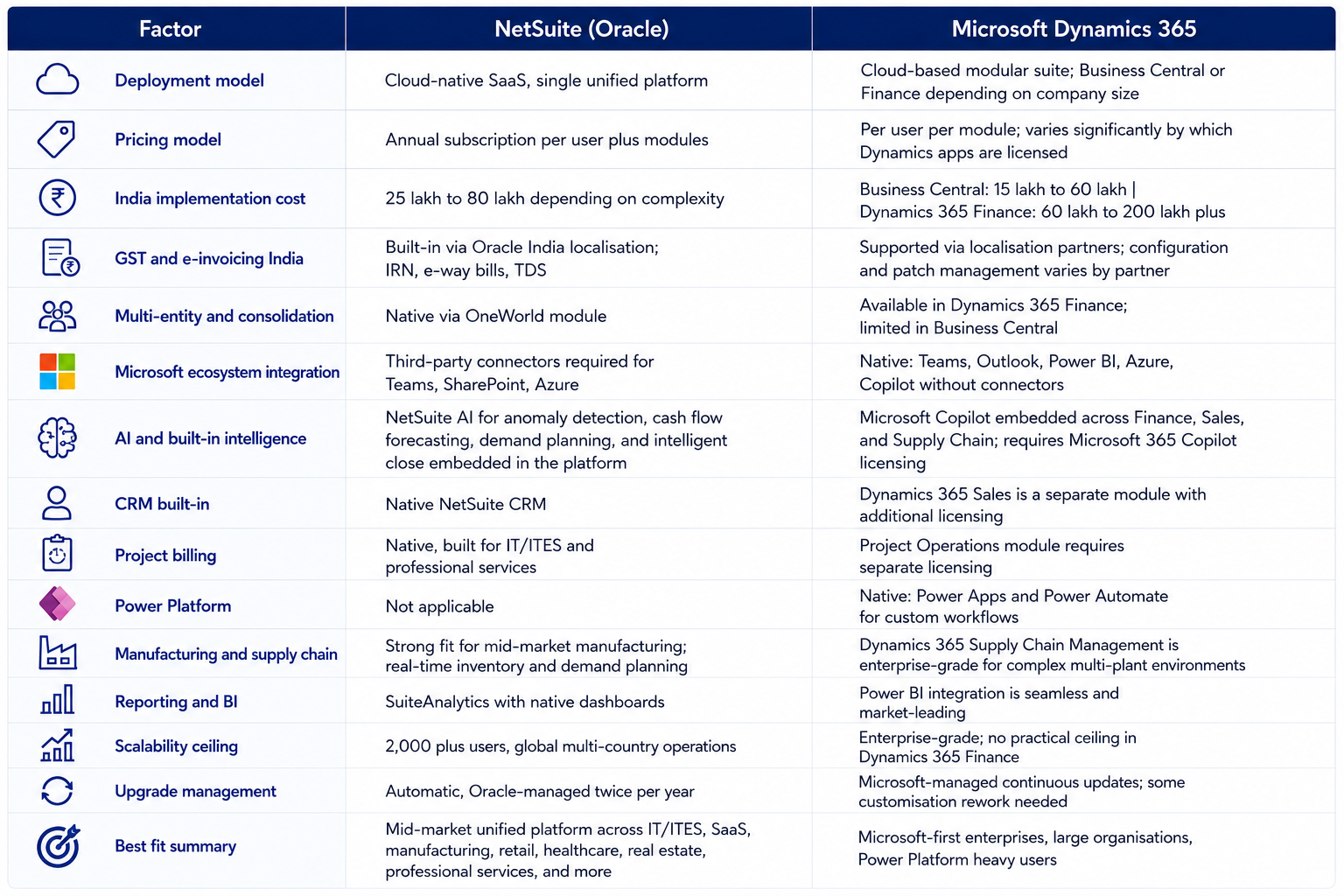
NetSuite puts every module on one data model. Finance, inventory, CRM, and project billing all share the same customer record, transaction history, and reporting layer. The NetSuite integration and automation layer connects third-party systems cleanly when needed, but the core business functions are unified without any assembly work. Dynamics 365 is modular, and connecting Finance, Sales, and Supply Chain requires integration effort, licensing across multiple modules, and ongoing synchronisation. For businesses that want a single source of truth without a systems integration project, NetSuite delivers it out of the box.
NetSuite's OneWorld module handles multi-entity financial consolidation natively intercompany eliminations, consolidated statements, and multi-currency consolidation for any number of entities without custom development. This is particularly valuable for real estate developers managing multiple project entities, professional services firms with regional subsidiaries, SaaS companies with international operations, and manufacturing groups with multiple plant entities. Dynamics 365 Business Central has limited multi-entity support. Dynamics 365 Finance handles it better but sits in a significantly higher cost bracket, making it over-engineered for most Indian mid-market businesses.
NetSuite covers a wide range of industry requirements natively:
NetSuite's AI in NetSuite capabilities are embedded directly in the platform and included in the subscription, no additional licensing required. This covers intelligent anomaly detection in financial transactions, cash flow forecasting, demand planning and inventory optimisation, smart matching for bank reconciliation, and guided close management. For finance teams across industries, these capabilities reduce manual review time and improve forecasting accuracy without adding tool complexity.
NetSuite's pricing is per user plus modules. Dynamics 365 pricing is per module per user, and the cost of assembling the right combination of Finance, Sales, Project Operations, and Supply Chain modules adds up quickly. For mid-market businesses in India doing a five-year TCO comparison, NetSuite's pricing is more predictable.
Both platforms support GST compliance in India. NetSuite's Oracle-managed localisation module handles GSTR-1, GSTR-3B, IRN generation, e-way bills, and TDS with patches delivered automatically. Dynamics 365 compliance in India is partner-managed, meaning patch delivery speed and quality depend on the implementation partner. Confirm explicitly how your Dynamics partner manages government-mandated compliance updates before committing.
Both platforms have certified implementation partners in India. NetSuite's partner ecosystem is smaller but more specialised. Dynamics 365 has a wider partner base due to Microsoft's broader market presence, but quality varies significantly. Business Central partners and Finance/Operations partners are distinct communities with different capability levels. Running a structured ERP evaluation process and asking for live references in your specific industry and revenue bracket is essential for both.
For a 50 to 150 crore Indian business evaluating both platforms, NetSuite is typically more cost-effective when you factor in the total Dynamics 365 module licensing needed to match NetSuite's out-of-the-box scope. A comparable Dynamics 365 implementation combining Finance, Sales, and Project Operations often costs 40 to 70 percent more than a NetSuite implementation covering the same functional scope.
Evaluating Dynamics 365 as a single product when it is a suite of separately licensed modules. The cost comparison changes significantly once you add the modules needed to match NetSuite's scope. The NetSuite vs Business Central guide covers this distinction in detail for businesses evaluating the SMB tier of the Dynamics range.
Choosing Dynamics because the business uses Microsoft 365, without validating whether the integration benefits justify the additional Dynamics module licensing costs.
Underestimating Dynamics customisation dependency. Power Platform is powerful, but custom workflows require ongoing maintenance and expertise that adds to long-term total cost of ownership.
Comparing Business Central against NetSuite's full suite. Business Central is Dynamics 365 for SMBs. For mid-market businesses beyond 100 crore rupees, the relevant comparison is Dynamics 365 Finance, which sits in a different cost bracket entirely.
Not accounting for Microsoft Copilot licensing. Copilot capabilities in Dynamics 365 require additional Microsoft 365 Copilot licensing, which adds to the per-user cost comparison.
Selecting an ERP based on general reputation rather than industry fit. The right platform depends on your revenue model, entity structure, and operational complexity, not just brand recognition.
If you are mapping your business stage and operational profile to the right platform, the CFO-focused guide on when to move to NetSuite covers the exact signals that tell you a modular, multi-licence approach will cost more than a unified suite over five years.
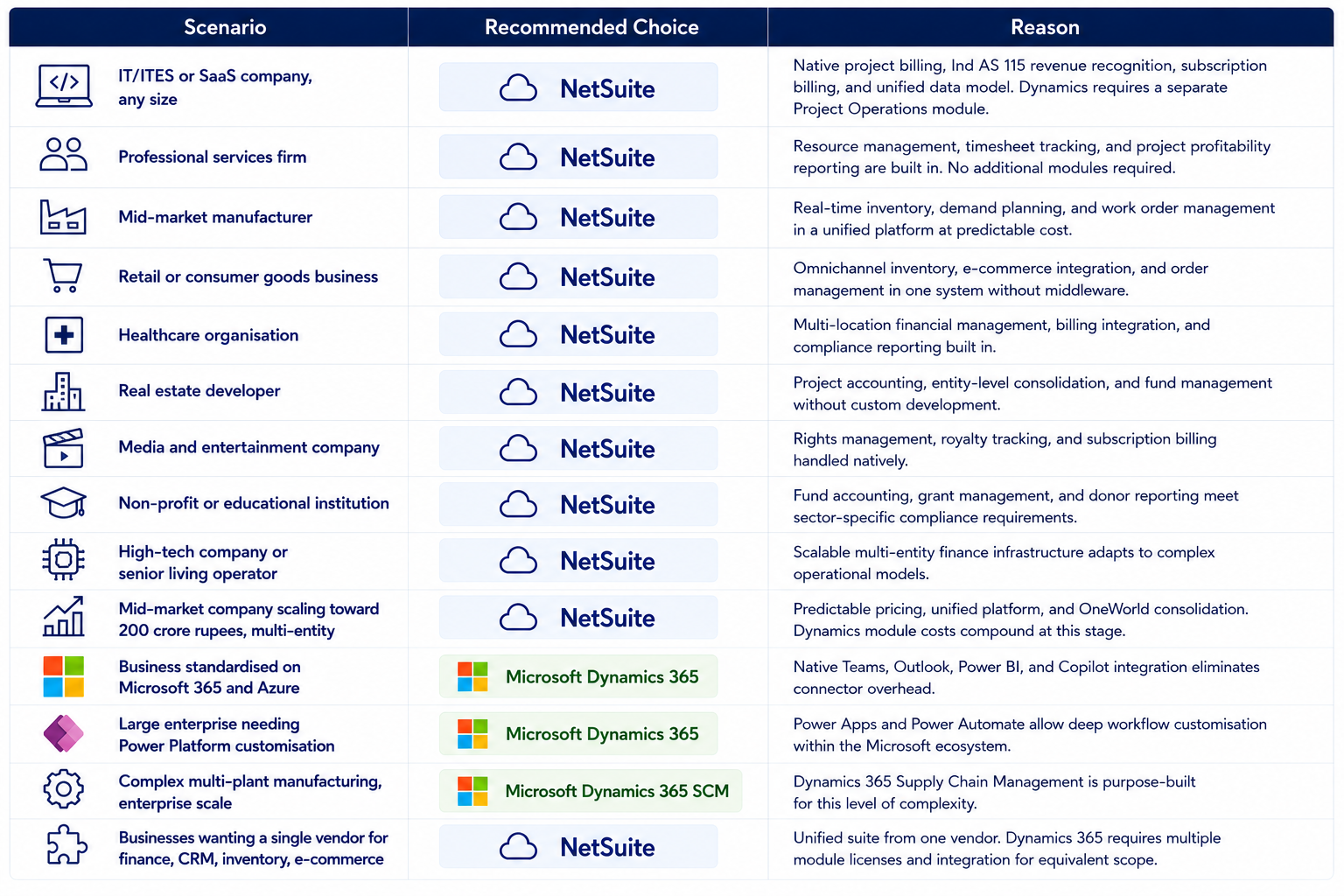
Microsoft Dynamics 365 is the right choice for businesses where the Microsoft ecosystem is already deeply embedded, including Azure, Teams, Power BI, and Copilot and where Power Platform customisation capabilities are a genuine operational requirement.
NetSuite is the stronger choice for a broad range of Indian mid-market businesses: IT/ITES companies, SaaS businesses, manufacturers, retailers, healthcare organisations, real estate developers, media companies, professional services firms, non-profits, educational institutions, and any business that wants a unified platform from day one without assembling and licensing multiple modules. For businesses scaling across entities in India and globally, NetSuite's multi-entity consolidation, built-in AI, and predictable pricing model deliver better value in the 50 to 300 crore revenue range.
The question to ask is not which platform is more powerful. It is which platform matches the actual operational profile and growth trajectory of your business, and which one will still be the right fit in three years.
SaasWorx is a certified Oracle NetSuite implementation partner with hands-on experience across IT/ITES, SaaS, manufacturing, retail, healthcare, real estate, media and entertainment, professional services, non-profit, education, insurance, high-tech, and senior living businesses in India, UAE, and North America. We evaluate your actual business requirements first and recommend the platform that genuinely fits.
We offer a free 60-minute ERP evaluation consultation with no obligation. We map your processes to the right platform and give you a grounded, India-market recommendation.
Is NetSuite better than Microsoft Dynamics 365?
NetSuite is better than Microsoft Dynamics 365 for businesses that want a unified ERP suite without assembling multiple modules, particularly IT/ITES companies, SaaS businesses, manufacturers, retailers, healthcare organisations, real estate developers, and other mid-market firms with multi-entity structures. Microsoft Dynamics 365 is better for businesses already standardised on the Microsoft ecosystem who want native Copilot AI, Power Platform customisation, and seamless Teams and Power BI integration.
What is the implementation cost of Microsoft Dynamics 365 in India?
Microsoft Dynamics 365 Business Central implementation in India typically costs between 15 lakh and 60 lakh rupees. Dynamics 365 Finance, the enterprise-tier module, typically costs 60 lakh to 200 lakh rupees and above depending on complexity. These figures cover implementation only; module licensing fees are separate and charged per user per month.
Can NetSuite replace Microsoft Dynamics 365?
Yes, NetSuite can replace Microsoft Dynamics 365 and is a common choice for businesses that find Dynamics 365 module licensing costs too high or want a single unified platform. NetSuite covers finance, CRM, inventory, project billing, and e-commerce in one system. The main area where NetSuite does not replicate Dynamics 365 is deep Microsoft ecosystem integration with Teams, Copilot, and Power Platform.
Does Microsoft Dynamics 365 support GST in India?
Yes, Microsoft Dynamics 365 supports GST compliance in India, including GSTR-1, GSTR-3B, e-invoicing, and e-way bills through its India localisation. However, unlike NetSuite where compliance updates are Oracle-managed, Dynamics 365 compliance patching in India is partner-managed. Confirming your implementation partner's track record on timely compliance updates is essential.
What is the difference between Dynamics 365 Business Central and Dynamics 365 Finance?
Dynamics 365 Business Central is Microsoft's ERP for small and mid-sized businesses covering core finance, inventory, and basic operations at lower licensing costs. Dynamics 365 Finance is the enterprise-tier module with advanced financial management, multi-entity consolidation, and regulatory compliance features. They are distinct products with different pricing, implementation complexity, and functional scope.
Which ERP is best for IT services companies in India?
NetSuite is the leading ERP choice for IT services companies in India. It includes native project billing, resource management, timesheet tracking, and Ind AS 115-compliant revenue recognition, all core requirements for project-based IT businesses. Microsoft Dynamics 365 requires the separately licensed Project Operations module to cover equivalent functionality.
Does NetSuite integrate with Microsoft Teams?
NetSuite does not integrate natively with Microsoft Teams. Integration requires third-party connectors or custom development. Microsoft Dynamics 365, by contrast, integrates natively with Teams, Outlook, SharePoint, and Power BI without additional connectors. For businesses where Teams-embedded ERP workflows are a requirement, this is a material differentiator in favour of Dynamics 365.
Which ERP is best for manufacturing companies in India?
For mid-market manufacturers in India, NetSuite provides real-time inventory management, demand planning, work order management, and multi-location stock visibility in a unified platform at a predictable cost. For large enterprises with complex multi-plant, multi-tier production environments, Dynamics 365 Supply Chain Management offers deeper manufacturing-specific functionality.
Does NetSuite support non-profits and educational institutions?
Yes. NetSuite includes fund accounting, grant management, donor tracking, and the reporting capabilities required by non-profit and educational organisations. The platform supports fund-level budgeting, restricted and unrestricted fund management, and compliance reporting, making it a strong fit for organisations with mission-driven finance requirements.