ERP RFP Template for Indian Companies: Requirements to Include for GST, TDS, and Audit Trail



Let’s Work Together
Summarize this blog post with:

Quick Summary
- Most ERP RFPs that reach vendors in India look the same. Twenty pages on dashboards, mobile apps and AI, and one line that says "must be GST compliant".
- That one line is where projects go wrong. Every vendor will tick "yes". Very few will show you what happens when an invoice misses the 30-day IRP window, or how a vendor payment is handled across the switch from the Income-tax Act, 1961 to the Income-tax Act, 2025.
- This guide gives you an ERP RFP template built for Indian companies, whether you are a manufacturer in Pune or a services firm in Bengaluru. It spells out the GST, TDS, and audit trail requirements so vendors have to answer them properly, not with a tick box.
Introduction
Choosing an ERP in India is no longer just a features decision. GST e-invoicing deadlines, the new TDS sections under the Income-tax Act, 2025, and the MCA audit trail rule all depend on how the system is built and set up. A well-structured ERP RFP template puts these requirements on paper before the first demo, so you compare vendors on what they can prove, not what they promise. Below, we cover what to include, the statutory checklist for GST, TDS, and audit trail, and a simple way to score vendors.
What Should an ERP RFP Include for an Indian Company?
An ERP RFP for an Indian company should cover your business context, functional requirements by module, India statutory requirements (GST, TDS/TCS and the Companies Act audit trail), technical and data needs, implementation approach, support terms, a three-year cost breakdown, and the scoring method you will use.
The RFP is one step in a wider 10-step ERP evaluation process, but it is the step that decides what vendors actually commit to. Here is the structure we recommend.
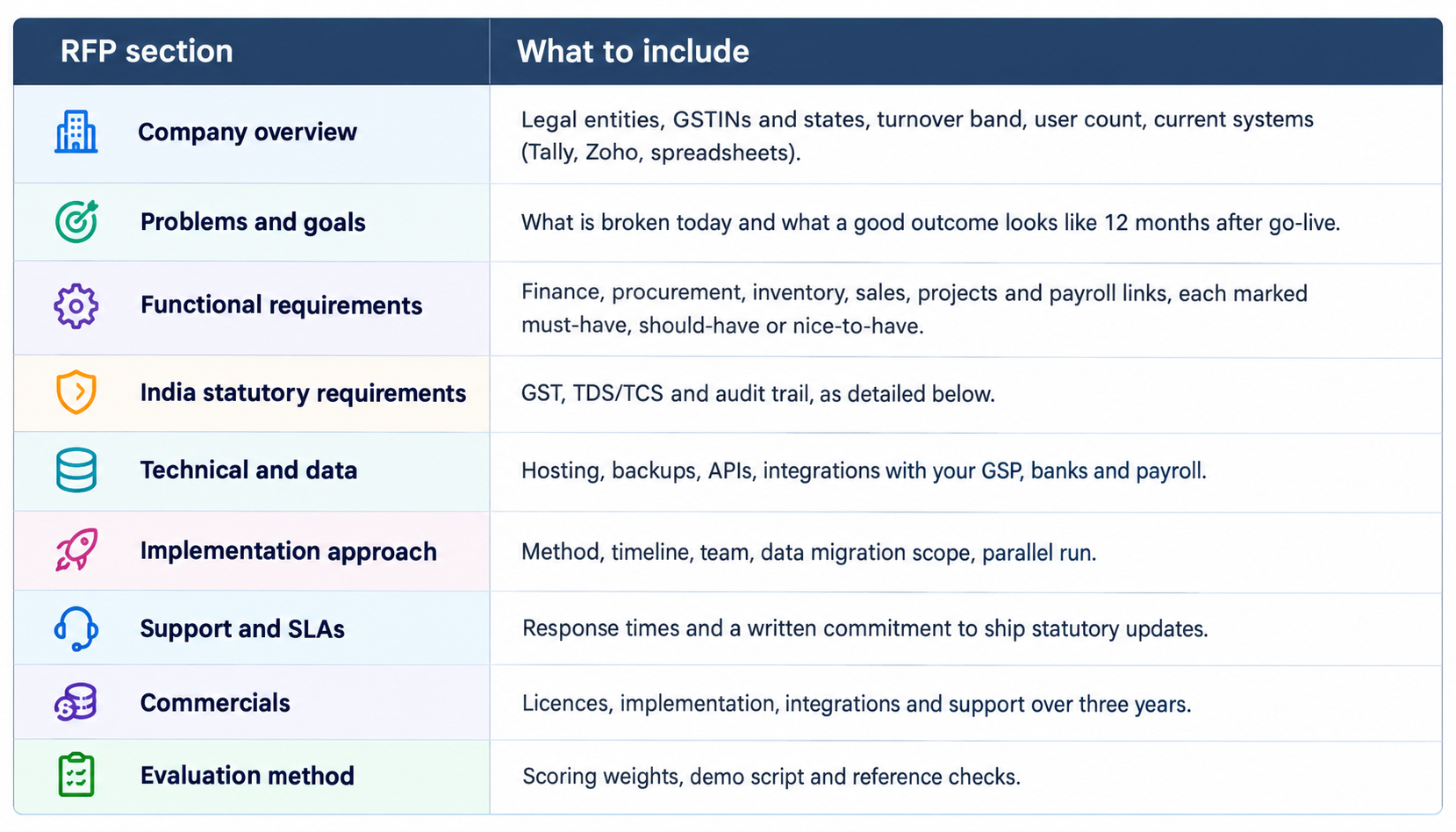
Treat this table as your ERP requirements checklist. If a section is missing, vendors will fill the gap with their own assumptions.
GST Requirements to Include in Your ERP RFP
Do not write "GST compliant". Ask vendors to show each of these in a demo, using your own sample data.
- Multiple GSTINs: one company registered in several states, each with its own invoice series and returns.
- E-invoicing from inside the ERP: IRN and QR code generated through your GSP or a direct API. E-invoicing applies once aggregate turnover has exceeded ₹5 crore in any financial year from 2017-18.
- The 30-day IRP window: if your turnover is ₹10 crore or more, invoices and credit or debit notes must be reported within 30 days, as per the GSTN advisory applied from 1 April 2025. Ask how the ERP flags documents nearing the limit.
- E-way bills generated from the dispatch document, not keyed in again on the portal.
- HSN/SAC codes and tax rates on item masters, with effective dates so a rate change does not mean re-coding.
- Input tax credit reconciliation: purchase register against GSTR-2B, with actions taken in the Invoice Management System (IMS).
- Special supplies: reverse charge, exports under LUT, and SEZ supplies.
- Return data for GSTR-1 and GSTR-3B built from posted transactions, with drill-down to each invoice.
TDS and TCS Requirements to Include
This is the part most ERP RFP templates online miss, because the law changed on 1 April 2026. The Income-tax Act, 2025 replaced the 1961 Act. Rates and thresholds were broadly carried over, but the old TDS sections (192 to 194T) now sit mainly under Section 392 for salaries and Section 393 for other payments, with new forms under the Income-tax Rules, 2026. Keep a TDS section mapping handy when you write this part.
Ask vendors to confirm the ERP can:
- Hold the TDS nature of payment, PAN status, and any lower-deduction certificate on each vendor record.
- Apply the old or new section based on the date of payment or credit. A professional fee credited in March 2026 but paid in April 2026 still falls under the 1961 Act.
- Track single and aggregate thresholds per vendor across the year.
- Apply the higher rate automatically when PAN is missing or inoperative.
- Produce challan, quarterly return, and certificate data in the new formats.
- Handle TCS on the sales side where it applies.
- Pull salary TDS from payroll if payroll runs outside the ERP.
Audit Trail Requirements Under the Companies Act
Since 1 April 2023, every company that keeps its books in accounting software must use software that records an audit trail of every transaction, keeps an edit log with the date of each change, and does not allow the audit trail to be disabled. This comes from the proviso to Rule 3(1) of the Companies (Accounts) Rules, 2014, and your statutory auditor reports on it under Rule 11(g). The ICAI's CA Journal has a clear summary of these audit trail requirements.
Your RFP should ask the vendor to confirm:
- Every create, edit, and delete on a transaction records who made it, when, and what changed.
- No role, including the vendor's own administrators, can switch the audit trail off at application or database level.
- Logs are kept for at least eight financial years, in line with Section 128.
- Auditors can run and export audit trail reports without vendor help.
- Backups of your books are taken daily on servers located in India.
- For cloud ERP, independent SOC 1 or SOC 2 reports are available for your auditor.
ERP Selection Criteria and a Simple Vendor Evaluation Template
Share your ERP selection criteria and their weights inside the ERP RFP itself. Vendors then know what matters, and your team scores everyone the same way.
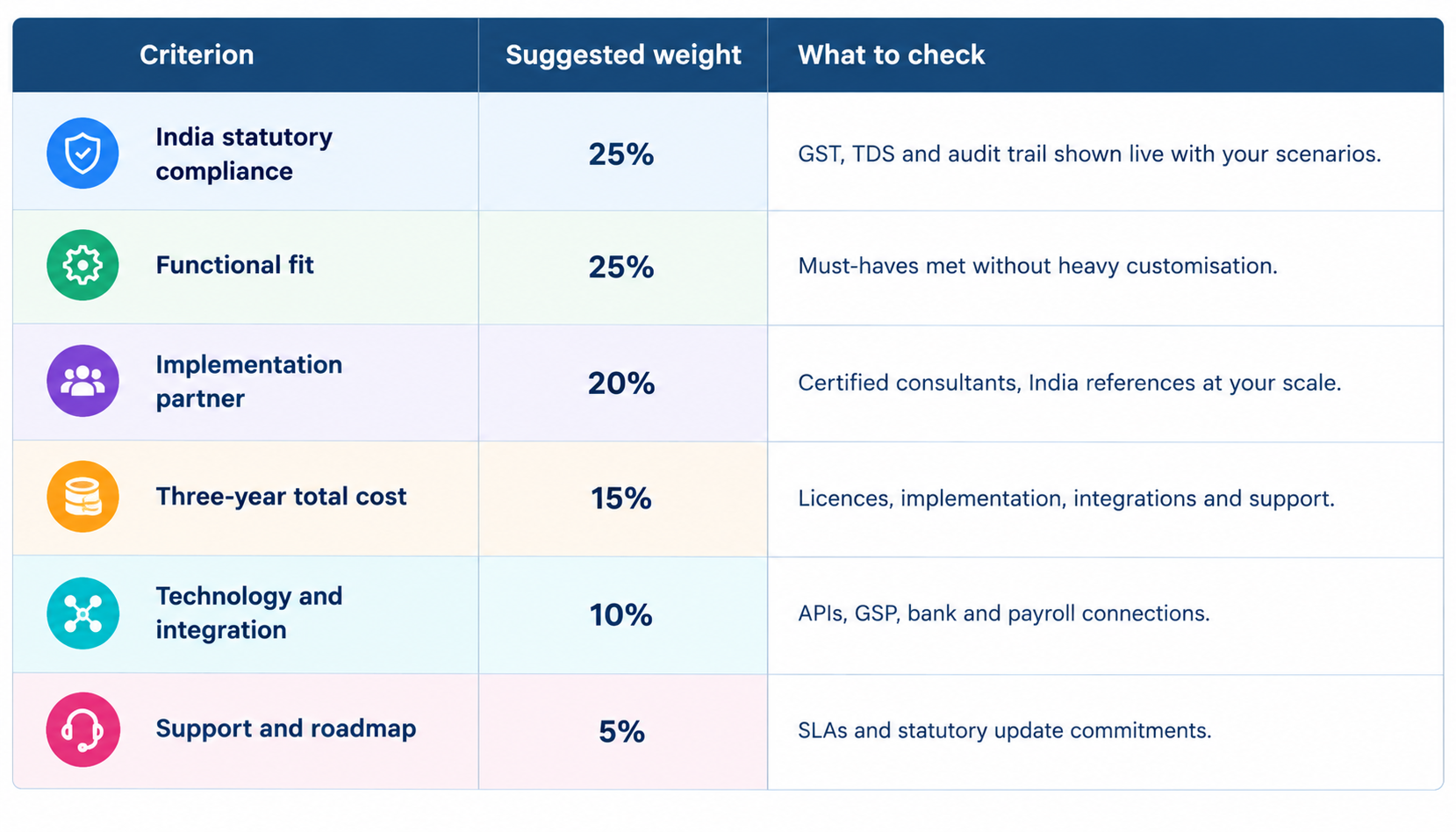
Score each criterion from 1 to 5, multiply by its weight, and add the results. That gives you a simple ERP vendor evaluation template you can run in a spreadsheet. Pair it with a scripted demo built from these ERP evaluation questions, so every vendor answers the same scenarios.
Frequently Asked Questions
What is an ERP RFP template?
An ERP RFP template is a ready structure for the request for proposal you send to ERP vendors. It lists your company details, requirements, commercial questions, and scoring method, so every vendor responds in the same format, and you can compare them fairly.
What is the difference between an ERP RFP and an ERP requirements checklist?
The requirements checklist is the list of what the system must do. The RFP wraps that checklist with your business context, implementation questions, pricing format, and evaluation criteria, and asks vendors to commit to answers in writing.
Do we need e-invoicing in the ERP if our turnover is below ₹5 crore?
It is not mandatory yet, but include it as a should-have if you are growing. E-invoicing applies once aggregate turnover exceeds ₹5 crore in any financial year from 2017-18, and switching systems at that point is costly.
How should our RFP handle the Income-tax Act, 2025 TDS changes?
Ask vendors to show both old and new TDS section codes in the vendor master, driven by the date of payment or credit. Also ask when their new return and certificate formats went live, and how they ship future statutory updates.
Can a cloud ERP hosted outside India meet the audit trail rules?
The audit trail rule applies wherever the software is hosted. Ask the vendor how the edit log is protected, how long it is kept, where daily backups of your books are stored, and whether SOC reports are available for your auditor.
How many vendors should receive our ERP RFP?
Three to five is usually enough. More than five adds evaluation effort without improving the decision, so use your must-have requirements to filter the list first.
Final Thoughts
An ERP RFP is where you decide what "compliant" actually means for your business. Write the GST, TDS, and audit trail requirements in plain detail, score every vendor against the same criteria, and make them prove it in a demo with your data. That is how you avoid finding the gaps after go-live.
SaasWorx is a NetSuite implementation partner in India. If you are drafting an ERP RFP, we are happy to review it with you, even if NetSuite is only one of the vendors on your list. No sales pitch, just a working session.