Pre-IPO Finance Systems Checklist: What Auditors, Bankers and Investors Will Test


Let’s Work Together
Summarize this blog post with:

Quick Summary
Auditors test whether your controls work: IFC internal financial controls, CARO 2020 reporting, and the audit trail in your accounting software.
Merchant bankers test whether your numbers hold up: Three years of restated consolidated financials and KPIs certified under SEBI's KPI Standards.
Investors test whether you can repeat it every quarter: Results within 45 days of quarter-end, and the same KPIs reported after listing.
Most IPO delays are systems gaps, not accounting gaps. Give your finance stack at least 18 months before the DRHP.
Every IPO-bound company in India eventually hears the same question from its bankers: "Can your system produce this?" Not whether you have the number, but whether the system can produce it consistently, with an audit trail, for three years back and every quarter forward.
That is what pre-IPO finance systems really means. Auditors, merchant bankers and investors each test your finance function from a different angle, and every test lands in the same place: your ERP, your controls and your data. It is also why so many tech IPOs standardise on NetSuite well before they file.
This checklist breaks down what each group will test and which finance systems you need in place for IPO readiness in India, whether you are a SaaS company in Bengaluru or a manufacturer in Pune.
What Finance Systems Do Indian Companies Need Before an IPO?
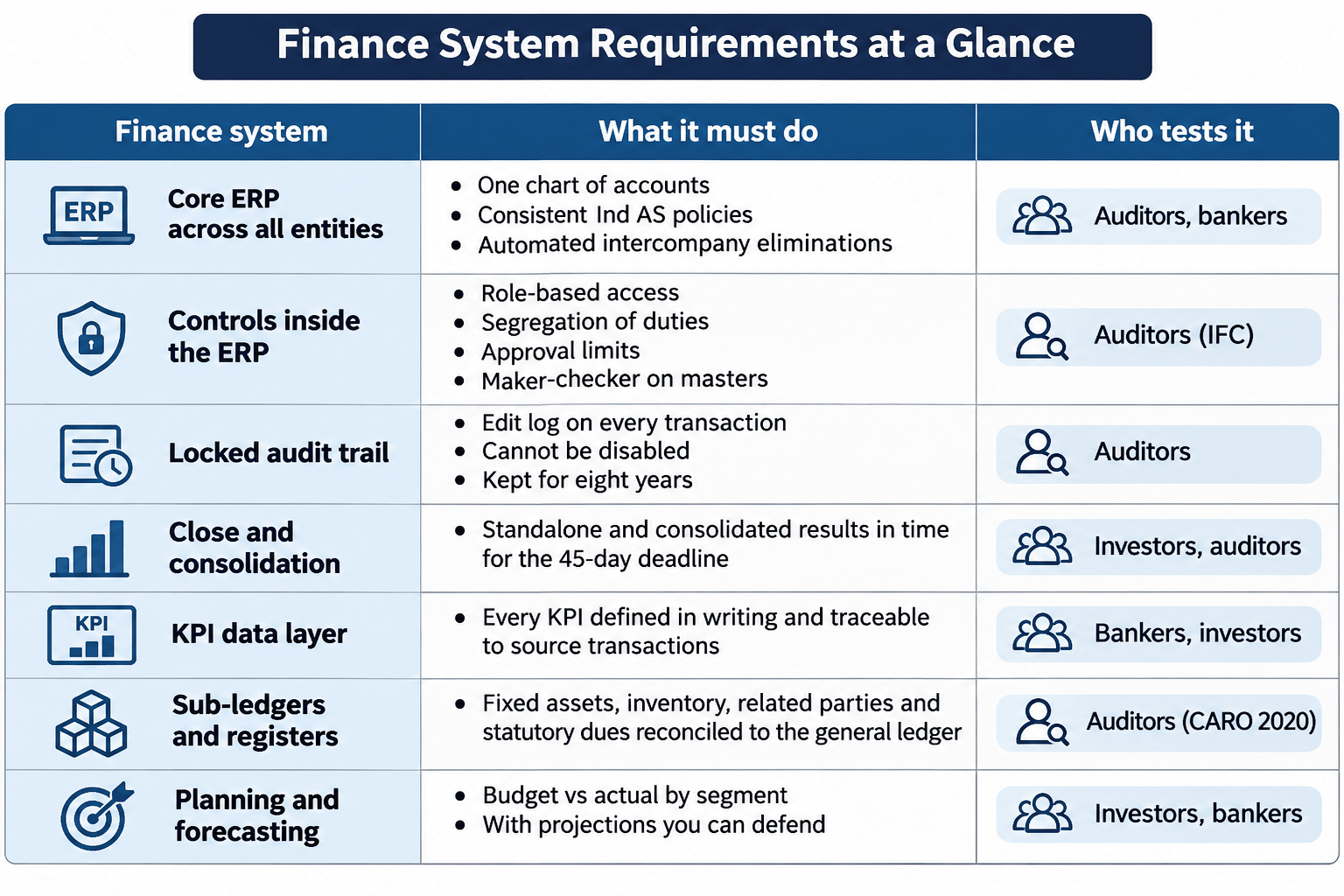
Before an IPO, an Indian company needs one ERP across all entities, controls built into that ERP, an audit trail that cannot be switched off, a close and consolidation process that produces Ind AS results within weeks, a governed source for every KPI, and registers for assets, related parties, and statutory dues that reconcile to the books.
What Auditors Will Test
Your statutory auditor will form views on three things that come straight from your systems: internal financial controls, CARO 2020 matters, and the audit trail.
IFC Internal Financial Controls
Under Section 134(5)(e) of the Companies Act, 2013, directors of a listed company must confirm that internal financial controls are adequate and operating effectively. Under Section 143(3)(i), the auditor reports on internal financial controls over financial reporting.
Here is the trap. A private company with turnover below ₹50 crore and borrowings below ₹25 crore is exempt from auditor IFC reporting. But you must convert to a public company before filing the DRHP, and unlisted public companies get no size-based exemption. Build your risk and control matrix before conversion, not after.
Auditors will look for:
- A documented risk and control matrix across procure-to-pay, order-to-cash, payroll, treasury, and financial close.
- Evidence that controls operated through the year, not just on paper.
- Segregation of duties enforced by the system, not by trust.
CARO 2020 Reporting
CARO 2020 has 21 reporting clauses, and the ICAI Guidance Note on CARO 2020 explains each one. Like the IFC exemption, CARO's private-company exemptions fall away once you become a public company. Several clauses are really system outputs:
- Property and assets: a fixed asset register with physical verification, and title deeds held in the company's name.
- Inventory and bank returns: where working capital limits above ₹5 crore are secured on current assets, the quarterly statements filed with banks must agree with the books. Stock statements built in Excel are a common failure point.
- Statutory dues: deposited on time, with disputed amounts listed.
- Internal audit: a system that matches the size and nature of the business.
Audit Trail
Since 1 April 2023, accounting software must record an edit log of every change that cannot be disabled, and auditors report on it under Rule 11(g). The ICAI's CA Journal sets out these audit trail requirements clearly. If you changed ERP mid-period, the old system's logs must be preserved too.
What Merchant Bankers Will Test
The book running lead managers carry responsibility for the offer document, so their diligence goes deep into your numbers.
Restated financials
SEBI's ICDR Regulations require restated consolidated financial information for the last three financial years, plus a stub period where needed, examined by a peer-reviewed chartered accountant. Restatement applies one set of Ind AS policies across all three years. Every adjustment you cannot explain from source data becomes a question.
KPIs
For offer documents filed from 1 April 2025, SEBI's KPI Standards apply. KPIs must be approved by the audit committee and certified by the statutory auditor or a peer-reviewed chartered accountant or cost accountant. Any KPI shared with investors in the three years before filing must also be disclosed. If a funding deck said "ARR of ₹180 crore", bankers will ask how it was calculated and whether your system can reproduce it today.
Diligence requests
Expect requests for month-wise revenue tied to invoices, related party transactions with approvals and arm's length support, tax demands and litigation, and a cap table that reconciles to share capital and ESOP records. A CFO's personal spreadsheet does not count as a source.
What Investors Will Test After Listing
Listing is the start of the test, not the end. Investors judge you on whether the same quality of numbers arrives every quarter, on time.
- Speed: under Regulation 33 of the SEBI LODR Regulations, quarterly results are due within 45 days of quarter-end and audited annual results within 60 days, both standalone and consolidated. That needs a faster month-end close than most private companies run today.
- Sign-off: the CEO and CFO certify the financial results and the internal controls behind them under Regulation 17(8).
- KPI continuity: the KPIs in your offer document must keep being disclosed at least once a year, until one year after listing or until the IPO proceeds are used, whichever is later. Any change in how a KPI is calculated must be explained.
- Consistency: segment numbers, guidance, and actuals must tie back to the same data every quarter. Markets forgive a weak quarter faster than a restated one.
Common Finance Red Flags That Delay an IPO
At SaasWorx, we see the same issues come up again and again when IPO-bound companies review their finance stack:
- Ind AS in Excel: Books kept under Indian GAAP, with Ind AS adjustments made in spreadsheets at year-end.
- Several systems, one spreadsheet: Each entity on a different accounting tool, consolidated by hand every month.
- Audit trail gaps: Logs lost during a software change, or an admin role that can switch them off.
- Bank statements that don't match: Quarterly stock statements to lenders built outside the ERP and never reconciled.
- Untraceable KPIs: Metrics shared in funding rounds that no one can rebuild from source data.
- Undocumented related party deals: Promoter loans, shared premises, or group charges without approvals or pricing support.
- Shared logins: Several people using one user ID, which makes segregation of duties impossible to prove.
Each of these is fixable. None of them is fixable in the three months before filing.
Frequently Asked Questions
What does pre-IPO finance readiness mean?
It means your finance function can produce audited, consistent, Ind AS numbers and KPIs from its own systems, with working controls and a complete audit trail, to the standard auditors, merchant bankers and public investors expect.
When should we start preparing our finance systems for an IPO?
At least 18 months before you plan to file the DRHP. That gives you time to fix systems and still have a full financial year of clean data and operating controls before the restated period is finalised.
Is IFC reporting mandatory for a private company planning an IPO?
A private company with turnover below ₹50 crore and borrowings below ₹25 crore, and no filing defaults, is exempt from auditor IFC reporting. That exemption ends once you convert to a public company, which is required before filing the DRHP. Directors' responsibility for controls applies regardless.
Which CARO 2020 clauses cause the most trouble before an IPO?
Title deeds not in the company's name, quarterly bank stock statements that don't agree with the books, delays in statutory dues, and weak internal audit are the most common. All four depend on clean registers and reconciliations inside your ERP.
Do KPIs in the DRHP need to be certified?
Yes. KPIs must be approved by the audit committee and certified by the statutory auditor or a peer-reviewed chartered or cost accountant. KPIs shared with investors in the previous three years must also be disclosed.
Can we change our ERP during the IPO process?
You can, but it is risky close to filing. A migration in the middle of the restated period adds reconciliation work and audit trail questions. If you need a new ERP, move early enough that at least one full financial year runs on it before the DRHP.
Conclusion
Auditors, bankers and investors ask different questions, but they all test the same thing: whether your numbers come from a system you can trust. Pre-IPO finance readiness is less about one big clean-up and more about running the business on controlled, traceable data long before the DRHP is drafted.
SaasWorx is a NetSuite implementation partner in India and works with growth companies preparing for IPO readiness in India. If you want a second view on whether your finance stack will hold up to diligence, we are happy to walk through it with you. No sales pitch, just a working session.