The True Cost of ERP Implementation: Hidden Expenses, Licensing Models, and TCO Explained


Let’s Work Together
Summarize this blog post with:

Quick summary
• ERP implementation cost is more than the license fee. A real five-year total cost of ownership (TCO) adds services, data migration, connections to other tools, training, staff time, support, and yearly price hikes.
• Panorama Consulting's 2026 ERP Report found that more than a quarter of companies went over budget. The top cause was extra technology they had not planned for.
• The five main licensing models are per-user subscription, consumption-based, perpetual with maintenance, open source, and custom enterprise agreements. Each one shifts cost to a different place.
• AI is now a separate line item. Assistants are often bundled, while agents are usually metered by usage.
• To protect your budget: model five years, cap renewals in writing, run a fit-gap review before signing, and hold a contingency.
You asked for an ERP quote and got a number. It looks clear. It is not the number you will pay.
ERP implementation cost depends on far more than software fees. It covers the people who set the system up. It covers the data you move in and the tools you connect. It also covers the price changes that hit at renewal. Finance leaders who compare only license fees tend to find the rest mid-project.
This guide shows where ERP money goes. It compares the main licensing models. It also shows how to build a five-year TCO you can defend to your board. The examples lean on NetSuite and SAP, but the method works for any vendor.
What does ERP implementation really cost?
ERP implementation cost is the sum of software fees, implementation services, data migration, integrations, training, and the internal time your team spends on the project. Vendors rarely publish one price, because every quote depends on your users, modules, legal entities, and scope. That is why a five-year view beats a year-one quote.
Here are the cost layers to price before you sign:
• Software: Subscription or license fees, by user type and module
• Implementation services: Process design, configuration, testing, and project management
• Data migration: Cleanup, mapping, and several test loads
• Integrations: CRM, payroll, banks, tax tools, and BI
• Training and change management
• Internal staff time, including backfill for people pulled onto the project
• Support, hosting, and upgrades after go-live
• Price increases at renewal
Why ERP budgets slip
Budget overruns are common, and the data on them is easy to misquote. You will see claims that 70% or 75% of ERP projects fail. Those figures often blend budget misses, late go-lives, and missed benefits into one number. Narrower, sourced figures serve you better.
The Panorama Consulting 2026 ERP Report found that more than a quarter of companies went over budget. The most common cause was a need for extra technology that nobody planned for. Panorama's team noted that companies often find big gaps late. Then they buy more tools, widen the scope, or write custom code. TechTarget's coverage lists the top five reasons for overruns: scope growth, technical issues, organizational issues, too little staff planned, and extra technology purchases.
Panorama also found that people issues, such as weak governance and resistance to change, were the top cause of late projects. The median project took about nine months.
Gartner takes a wider view. It predicts that by 2027, more than 70% of recent ERP projects will miss the goals in their original business case. Up to 25% may fail badly. Missing a business case is not the same as running over budget. Both start with the same gaps in planning.
Hidden ERP costs to budget for
These lines rarely appear in a first proposal.
1. Data migration and cleanup: Old systems hold duplicate customers, mismatched item codes, and accounts nobody recognizes. Cleaning it takes time, and you usually need several test loads. Our NetSuite data migration checklist covers the steps.
2. Custom code: Every custom script needs care at each upgrade. The more you bend the system, the more you pay to keep it working.
3. Integrations: Your ERP must talk to CRM, payroll, banks, and tax tools. Each link needs a build, an owner, and a fix plan after upgrades. See how a NetSuite and Salesforce integration is structured.
4. Extra technology: This is Panorama's top overrun cause. Gaps in billing, reporting, warehouse, or tax features push teams to buy add-on tools mid-project.
5. Internal staff time: Finance, operations, and IT experts spend weeks in workshops and testing. Their regular work still needs cover.
6. Change management and training: A system nobody uses costs money every month. Our guide to common ERP implementation challenges explains how weak change management derails projects.
7. Post go-live support: Expect a settling-in period, user questions, report requests, and tuning work.
8. Renewal increases: These compound quietly, as the next section shows.
ERP licensing models compared
Licensing decides when you pay and how cost grows. Five models cover most of the market.
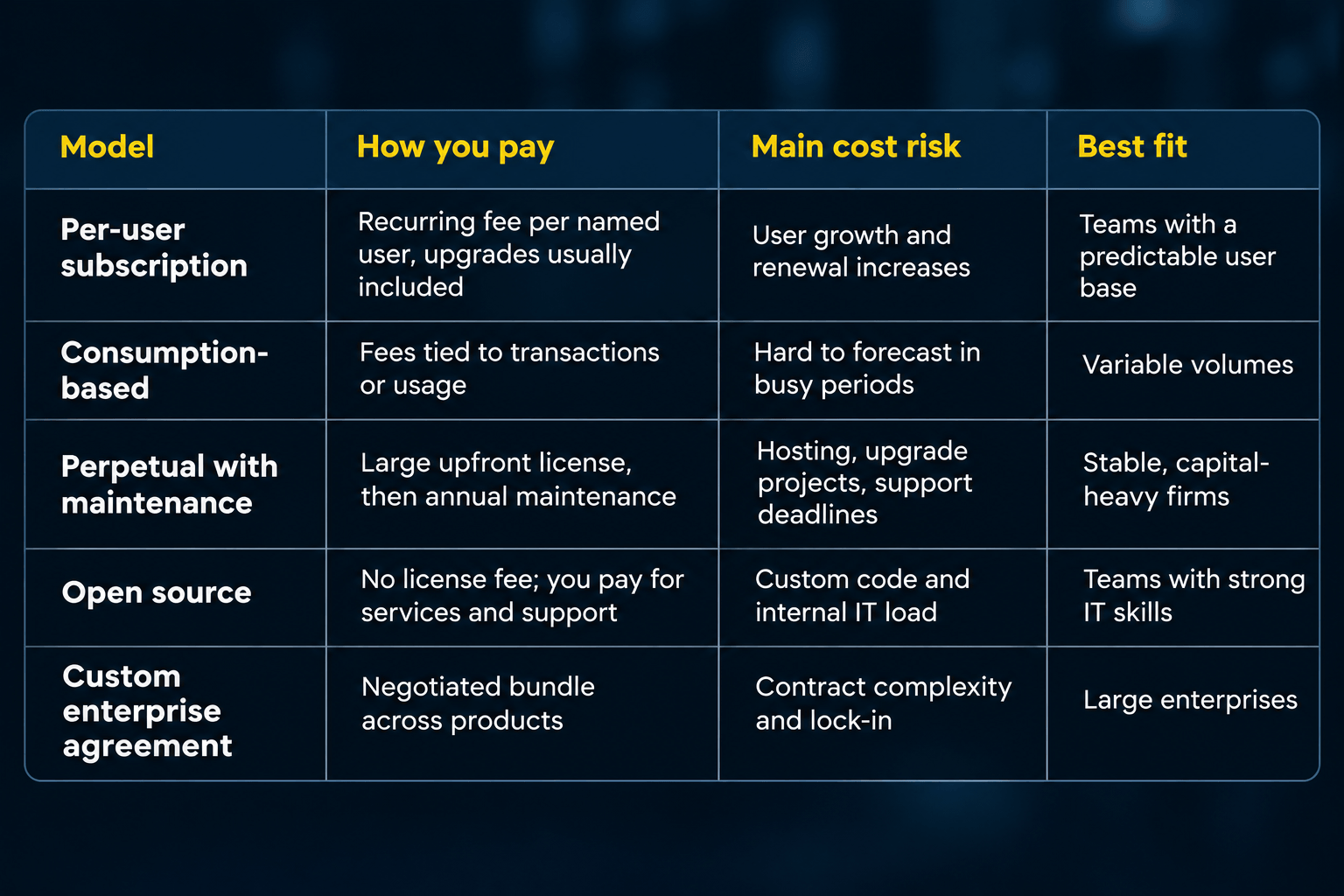
How NetSuite pricing is built
NetSuite shows how several levers combine. A subscription has a base platform license, per-user licenses, and add-on modules, billed annually. Oracle does not publish a single rate card, so each quote differs. Upgrades arrive twice a year as part of the subscription. Count users by role, because full users and self-service users are priced differently.
Our NetSuite vs Odoo and NetSuite vs SAP Business One comparisons show how these models play out against other vendors.
Renewal increases: The cost that compounds
Your first-term price is often the best price you will see. Renewals can add increases on top of any new users or modules. Here is an illustration with made-up figures. Assume a $100,000 subscription in year one, with no new users or modules.
• At 10% a year with no cap, year five costs $146,410 and the five-year total is $610,510.
• At 3% a year with a cap, year five costs $112,551 and the five-year total is $530,914.
• The gap over five years is $79,596.
Your contract sets the real number, which is why the renewal cap matters as much as the opening discount. Ask for:
• A written annual cap in the order form
• Price protection for users and modules added mid-term
• The right to reduce seats at renewal
• Clear notice periods
Our ERP selection checklist lists every question to send before you sign.
AI pricing is the new hidden line
Most major vendors now bundle a basic AI assistant and meter the agents that act on their own. The terms differ:
• SAP - Base AI, including the Joule assistant, comes with every cloud subscription. Premium AI, which covers agents, is priced in AI Units. In 2026, SAP-delivered agents use 0.02 AI Units per agent action, and unused AI Units expire after 12 months, per SAP's AI pricing page. SAP says its model is still evolving, so recheck terms at signing.
• Microsoft Dynamics 365 Business Central - Copilot is included in Essentials and Premium licenses. The Payables Agent and Sales Order Agent run on Copilot Credits, billed by usage through an Azure subscription.
• NetSuite - AI features are rolling out in phases. Confirm in writing what your edition includes and what is metered. Our recap of SuiteWorld 2026 AI announcements explains what Oracle announced.
Usage-based AI is hard to forecast before you have usage history. Ask each vendor for the meter rate, the included allowance, and an overage cap.
Legacy deadlines can raise your TCO
If you run SAP ECC 6.0, mainstream maintenance for enhancement packages 6 to 8 ends on December 31, 2027. Optional extended maintenance runs through 2030 (SAPinsider). Crowe reports that extended maintenance adds a 2% premium to your current maintenance fee.
Moving under deadline pressure costs more than moving on your own schedule. Our look at the India ERP market, cloud versus on-premise explains why many firms now plan early.
How to build a five-year ERP TCO
A five-year ERP TCO adds every one-time and recurring cost over 60 months. Then it tests the total against price hikes and project risk.
Five-year TCO = software fees + implementation + data migration + integrations + training + internal time + support + renewal increases + contingency
1. List each cost layer and mark it one-time or recurring.
2. Count users by role, not headcount, and split full users from light users.
3. Run a fit-gap review in writing. Mark each need as standard, configuration, or custom build. Our 20 critical ERP evaluation questions can guide the review.
4. Price integrations and add-on tools now, not mid-project.
5. Cost your internal team's time, including backfill.
6. Model renewals at a capped and an uncapped rate.
7. Add a contingency line and name who can approve its use.
Cost runs the other way too. Staying on disconnected tools carries a bill of its own. Business Next replaced Tally and QuickBooks with one NetSuite instance across four subsidiaries. It removed manual AR, AP, and project tracking bottlenecks, as the Business Next case study describes. Count the cost of manual work in your model as well.
Frequently asked questions
How much does ERP implementation cost?
There is no single price. Cost depends on users, modules, entities, integrations, data quality, and how much you customize. Published ranges vary widely by source and company size, so treat any single figure with care. Ask vendors and partners for a five-year estimate with stated assumptions.
What is ERP total cost of ownership?
ERP TCO is the full cost of owning the system over a set period, usually five years. It covers software fees, setup, data migration, integrations, training, staff time, support, and renewal increases.
What are the most common hidden costs of ERP?
Panorama's 2026 findings point to extra technology, scope growth, technical issues, organizational issues, and too little staff planned. Data problems and consulting costs also appear among reported causes.
Is cloud ERP cheaper than on-premise ERP?
Not automatically. Cloud ERP usually swaps a large upfront license for recurring subscription fees and bundles hosting and upgrades. On-premise perpetual licenses add maintenance, infrastructure, and upgrade projects. Compare five-year TCO for both, including renewal increases.
How can you avoid ERP budget overruns?
Run a fit-gap review before signing. Lock scope with change control. Clean data early. Budget for change management. Cap renewals in writing, and hold a contingency. Our 10-step ERP evaluation process walks through the early steps.
Price the whole system, not the quote
ERP cost rarely surprises teams that model it early. The surprises come from lines nobody priced. Think of migration, integrations, extra tools, staff time, AI usage, and renewals. Build the five-year view first. Then compare vendors on it.
SaasWorx has delivered more than 110 NetSuite implementations and can help you build that view. If you already run an ERP and suspect you are overpaying, a free ERP health check is a good place to start. Our NetSuite Optimisation Audit reviews licenses and configuration.